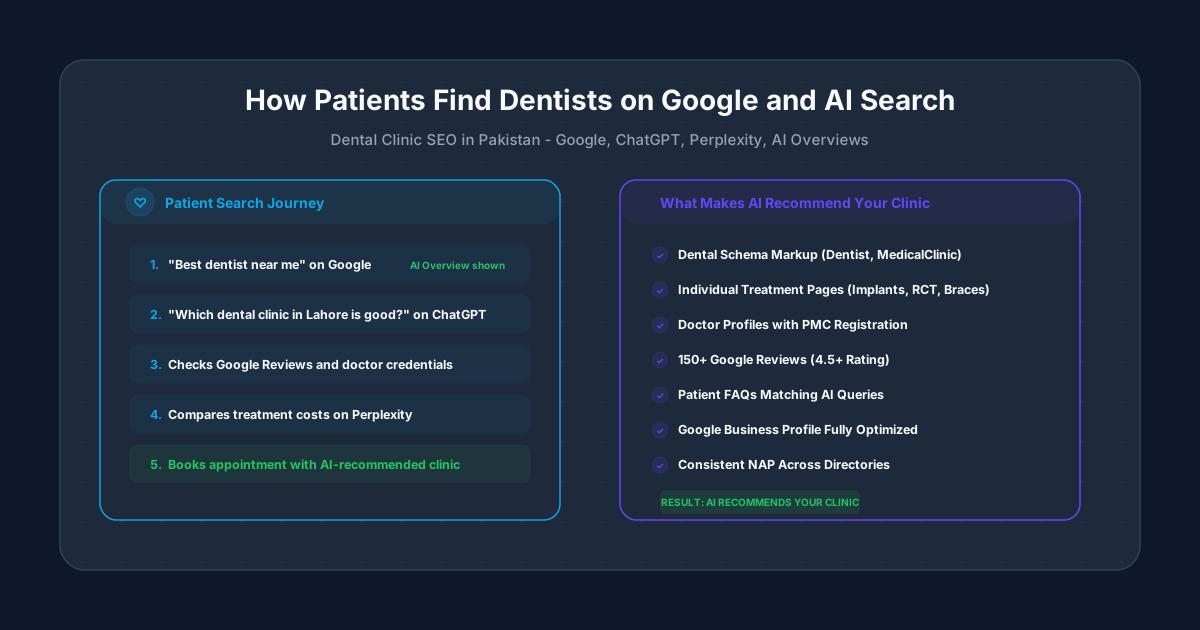
A patient in Lahore wakes up with a toothache. Ten years ago, they would have asked a neighbour for a recommendation or driven to the nearest clinic they remembered seeing. Five years ago, they would have Googled 'dentist near me' and picked from the map pack. Today, that same patient opens ChatGPT and types 'which dental clinic in Lahore is best for root canal treatment?' They get a direct answer with clinic names, price ranges, and reasons why each one is recommended. They pick one and call. No scrolling, no comparing ten websites, no confusion. This shift in how patients find dentists is not coming. It is already here. The dental clinics in Pakistan that understand this and adapt their online presence will capture patient demand that competitors do not even know exists. The clinics that ignore it will wonder why their phone stopped ringing despite having a perfectly good website.
The Two Ways Patients Find Dentists in 2026
Patient search behaviour in Pakistan now splits into two distinct paths. The first is traditional Google search: a patient types 'dentist near me' or 'best dental clinic in Islamabad' and sees a map pack with three clinics, followed by organic results. This still drives the majority of dental appointments. The second path is AI search: the patient asks ChatGPT, Perplexity, or sees a Google AI Overview that directly recommends specific clinics with reasons. This second path is growing fast, especially among younger patients and urban populations.
The critical insight for dental clinics is that both paths pull from the same underlying signals. A clinic that builds strong local SEO foundations, detailed treatment content, genuine patient reviews, and proper structured data will perform well on both traditional Google and AI platforms. The work is not two separate strategies. It is one strategy that feeds both channels simultaneously.
Why Most Dental Clinic Websites in Pakistan Fail at Search
Most dental clinic websites in Pakistan share the same problems. They have five to eight pages total: home, about, services (a single page listing everything), gallery, and contact. The services page lists 'Root Canal Treatment, Dental Implants, Teeth Whitening, Braces, Scaling' as bullet points with no detail. There are no individual treatment pages. There are no doctor profiles beyond a name and photo. There is no FAQ content. There is no schema markup. The Google Business Profile is incomplete with wrong hours or missing services.
This type of website is invisible to AI search platforms. When a patient asks ChatGPT 'which clinic in Karachi does dental implants?' the AI needs detailed, structured information to form a recommendation. A bullet point on a services page does not give it anything to work with. The clinics that AI platforms recommend are the ones that have published detailed, specific content about each treatment, each doctor, and each patient concern.
Building Treatment Pages That Google and AI Actually Use
Every treatment your clinic offers needs its own dedicated page. Not a section on a services page. A full, standalone page. This is the single highest-impact change most Pakistani dental clinics can make for both Google rankings and AI search visibility.
What Each Treatment Page Should Include
A treatment page for dental implants, for example, should cover what dental implants are and who needs them, the procedure steps from consultation to final crown placement, how long the process takes at your clinic, the types of implants you use and why, cost range in Pakistani Rupees (patients search for this constantly), who the treating dentist is with their qualifications, before and after cases if you have patient consent, recovery timeline and aftercare instructions, risks and how your clinic manages them, and FAQs specific to implants at your clinic.
This depth serves two purposes. For Google, it creates a highly relevant page that can rank for dozens of long-tail queries like 'dental implant cost in Lahore,' 'how long do dental implants take,' and 'best implant dentist in Pakistan.' For AI platforms, it provides the structured, authoritative information they need to confidently recommend your clinic when patients ask about implants.
Treatment Pages Every Dental Clinic Needs
- Dental Implants (single, multiple, All-on-4, zygomatic) - highest patient research volume and highest revenue per case.
- Root Canal Treatment - patients actively search for cost, pain level, and clinic recommendations before booking.
- Teeth Whitening (in-office and take-home) - high search volume, easy conversion, good entry point for new patients.
- Dental Braces and Clear Aligners (Invisalign, metal braces, ceramic braces) - long research cycle, patients compare clinics extensively.
- Dental Crowns and Bridges - patients search for cost comparisons and material differences (zirconia vs porcelain vs metal).
- Dental Veneers - cosmetic dentistry search volume is growing fast in Pakistani cities.
- Wisdom Tooth Extraction - high volume of urgent searches, patients want to know cost and recovery time.
- Scaling and Polishing - common search, good page for capturing routine care patients.
- Pediatric Dentistry - parents search specifically for child-friendly dentists.
- Emergency Dental Care - urgent searches with high conversion intent, needs clear availability information.
Doctor Profiles That Build Trust With Patients and AI
Every dentist at your clinic needs a dedicated profile page, not a paragraph in the about section. Patients check doctor credentials before booking, and AI platforms use doctor information heavily when making recommendations. A patient asking ChatGPT 'best dentist for implants in Karachi' can only get your doctor recommended if ChatGPT can find structured information about that doctor's implant expertise.
Each doctor profile should include their full name, photograph, BDS and postgraduate qualifications (FCPS, MDS, diplomas), Pakistan Medical and Dental Council registration, years of experience and areas of specialization, specific treatments they perform, any advanced training or certifications (laser dentistry, implantology courses, orthodontic training), languages spoken, and consultation availability. Implement Dentist schema markup on each profile page. This tells AI platforms exactly who practices at your clinic and what they specialize in.
Google Business Profile: The Most Underused Asset for Dental Clinics
Your Google Business Profile is often the first thing both Google and AI platforms reference when a patient searches for a dentist in your area. An incomplete or outdated profile is actively hurting your patient acquisition. Most dental clinics in Pakistan treat their Google Business Profile as a set-and-forget listing. They created it years ago and never updated it. This is a significant competitive mistake.
- Primary category: set to 'Dentist' or 'Dental Clinic' (not 'Medical Center' or 'Healthcare').
- Secondary categories: add every relevant one such as 'Cosmetic Dentist,' 'Orthodontist,' 'Pediatric Dentist,' 'Emergency Dental Service,' 'Dental Implants Provider.'
- Services: list every individual treatment with descriptions. Google shows these to searchers and AI uses them for recommendations.
- Business hours: include lunch breaks if applicable. Add special hours for Eid, national holidays, and Ramadan. Wrong hours destroy trust.
- Photos: upload clinic interior, treatment rooms, sterilization area, waiting area, team photos. Update quarterly. Clinics with 20+ photos get significantly more profile views.
- Posts: share weekly content such as dental health tips, new treatment announcements, or team achievements. Active profiles rank higher in map results.
- Q&A section: proactively add and answer common patient questions. Do not leave this empty for random users to fill with inaccurate information.
- Messaging: enable it if you can respond within a few hours. Patients increasingly prefer messaging over phone calls.
The Review Strategy That Drives Both Google Rankings and AI Citations
Reviews are the single strongest signal for local dental search rankings and AI recommendations. A dental clinic with 200 Google reviews averaging 4.6 stars will consistently outrank and out-cite a clinic with 15 reviews averaging 4.9 stars. Volume and recency matter as much as rating. AI platforms like ChatGPT explicitly reference review counts and ratings when recommending dental clinics.
- 1.Identify the right moment to ask. The best time is immediately after a successful treatment when the patient expresses relief or gratitude. Train your front desk staff and dental assistants to recognize this moment.
- 2.Make leaving a review effortless. Create a short link to your Google review page. Print it as a QR code on a small card handed to patients after treatment. Send it via WhatsApp or SMS within 2 hours of their visit.
- 3.Ask for specific feedback. Instead of 'Please leave us a review,' say 'Would you mind sharing your experience with Dr. [name] and the [treatment] you had today?' Specific reviews contain treatment names and doctor names that AI platforms extract.
- 4.Respond to every single review within 48 hours. Thank positive reviewers by name. Address negative reviews professionally with a genuine offer to resolve the concern. Your response pattern is visible to both patients and AI platforms.
- 5.Never buy or incentivize fake reviews. AI platforms are trained to detect fake review patterns, and Google penalizes clinics caught doing this. A sudden spike of 50 five-star reviews with generic text will hurt you, not help.
Schema Markup for Dental Clinics: Speaking AI's Language
Schema markup is the structured data format that helps search engines and AI platforms understand your website content as organized data rather than plain text. For dental clinics, proper schema implementation is the technical foundation that makes everything else work. Most dental clinic websites in Pakistan have zero schema markup. Adding it gives you an immediate advantage over competitors.
- Dentist schema on each doctor profile page with name, credentials, specialization, and medical registration.
- MedicalClinic or Dentist schema on your main clinic pages with address, phone, hours, departments, and accepted insurance.
- MedicalProcedure schema on treatment pages describing what each treatment involves.
- FAQPage schema on any page containing patient questions and answers. This makes your FAQs eligible for rich results on Google.
- LocalBusiness schema with geo-coordinates, service area, and payment methods.
- Review schema referencing your aggregate Google rating (only use if your rating is genuinely strong).
How AI Platforms Choose Which Dental Clinics to Recommend
Understanding how ChatGPT, Google AI Overviews, and Perplexity each work helps you optimize for all three simultaneously.
ChatGPT Recommendations
ChatGPT draws from its training data and web browsing to recommend dental clinics. It favours clinics with strong online presence across multiple sources: a detailed website, consistent directory listings (Marham, oladoc, Google Maps), genuine patient reviews, and authoritative content. When a patient asks 'best dental clinic in Islamabad for braces,' ChatGPT looks for clinics that have specific content about orthodontic treatment, named orthodontists with credentials, and positive patient reviews mentioning braces.
Google AI Overviews
Google AI Overviews pull from web pages that Google already ranks highly for health queries. The key difference is that AI Overviews extract direct answers rather than showing links. Your content needs to answer patient questions directly in the first paragraph, then expand. A treatment page that starts with 'Dental implants at [Clinic Name] in [City] cost between PKR X and PKR Y and take 3-6 months to complete' is far more likely to be extracted into an AI Overview than a page that starts with marketing fluff.
Perplexity Citations
Perplexity searches the web in real time and cites specific URLs. This means Perplexity citations drive actual website traffic to your clinic. To get cited, your pages need to be the most authoritative, clearly structured answer to specific dental queries. Perplexity particularly values pages with specific data points: treatment costs, procedure timelines, doctor credentials with verifiable registration numbers.
Local SEO Fundamentals That Feed AI Visibility
AI search visibility for dental clinics is built on top of strong local SEO. If your local SEO is weak, your AI visibility will be weak too. These fundamentals are table stakes.
- NAP consistency: your clinic name, address, and phone number must be identical everywhere. 'Dr. Ahmed Dental Clinic' on your website, 'Ahmed Dental' on Google Maps, and 'Dr. Ahmed Dental Care' on Marham confuses both Google and AI platforms.
- Directory listings: claim and complete your profiles on Marham.pk, oladoc.com, Healthwire.pk, Yelp, and Justdial Pakistan. Each listing should mirror your website information exactly.
- Location pages: if you have multiple branches, each needs its own page with unique content about that location, the dentists who practice there, and the specific services available at that branch.
- Mobile speed: over 80% of dental searches happen on phones. Your website must load in under 3 seconds on a mobile connection. Patients will not wait for a slow site when they have a toothache.
- Click-to-call: make your phone number tappable on mobile. Add WhatsApp click-to-chat if you monitor it. Dental patients often want to call immediately.
- City-specific content: create pages targeting '[treatment] in [city]' queries. 'Dental implants in Karachi,' 'teeth whitening in Lahore,' 'braces cost in Islamabad' are all high-intent searches.
Content Strategy: What to Publish and How Often
Dental clinics do not need to become content factories. They need a focused content strategy that builds authority on their core treatments and serves the questions patients actually ask. Quality over quantity applies strongly here because dental content falls under health topics where search engines apply stricter quality standards.
- Start with treatment pages for your top 5 revenue-generating procedures. These pages will do the most work for patient acquisition.
- Add a FAQ section to every treatment page with 5-8 questions patients commonly ask about that treatment. Use actual questions your reception staff hears daily.
- Publish one detailed blog post per month covering a specific patient concern: 'How to know if you need a root canal,' 'Dental implant vs bridge: which is right for you,' 'What to expect during wisdom tooth extraction.'
- Attribute all clinical content to a named dentist at your clinic with their qualifications. Anonymous dental content gets penalized by Google's health content standards.
- Update treatment pages every 6 months with current pricing, any new techniques or equipment, and fresh FAQs based on recent patient questions.
- Cross-link between related treatment pages. A patient reading about dental crowns should see a contextual link to your implant page and your veneer page where relevant.
Measuring What Matters: Dental Clinic Search Performance
Track the metrics that directly connect to patient bookings, not vanity numbers.
- Google Business Profile actions: calls, direction requests, website clicks, message requests. These are direct patient intent signals.
- Treatment page traffic: which pages get the most visits and which convert to calls or form submissions. Double down on what works.
- Search Console impressions for treatment queries: are you appearing for 'dental implants [city],' 'root canal cost [city],' and similar high-intent terms?
- Review volume and rating trend: track monthly new reviews and watch for rating changes. Set a target of 10-15 new reviews per month for a busy clinic.
- AI citation checks: manually test ChatGPT and Perplexity monthly with queries like 'best dentist in [your city]' and 'dental implant clinic [your city].' Track whether your clinic appears.
- New patient source: ask every new patient how they found you. Track the percentage who say Google, ChatGPT, or 'I searched online.' This is your ultimate ROI metric.
Common Mistakes That Kill Dental Clinic Search Visibility
These are the patterns we see repeatedly with dental clinics across Pakistan that struggle with search visibility despite having excellent clinical reputations.
- Single services page listing all treatments as bullet points. No ranking power, no AI citations, no patient trust.
- Stock photos instead of real clinic photos. Patients and AI platforms recognize generic stock imagery. Real photos of your clinic build trust.
- No pricing information anywhere. Pakistani patients search for dental treatment costs obsessively. Clinics that publish honest price ranges capture this demand. Those that hide pricing lose patients to competitors who are transparent.
- Outdated Google Business Profile with wrong hours or missing services. Patients who show up when you are closed leave negative reviews.
- No doctor profiles or just names without qualifications. Patients want to verify credentials before trusting someone with their dental health.
- Website not mobile-friendly. A dental clinic website that does not work well on phones is losing 80% of potential patients.
- Ignoring negative reviews instead of responding professionally. Unaddressed complaints signal to both patients and AI that the clinic does not care.
Getting Started: Priority Actions for This Week
You do not need to do everything at once. These actions are ordered by impact, so start from the top and work down.
- 1.Audit and complete your Google Business Profile today. Fix hours, add all services, upload 10 real photos, add your top 5 FAQs to the Q&A section. This takes 2 hours and is the fastest win.
- 2.Create treatment pages for your top 3 procedures this week. Start with the treatments that bring the most revenue or have the most competition. Each page should be 800-1200 words with cost information, procedure details, and FAQs.
- 3.Set up a review generation process. Print QR code cards, draft a WhatsApp template message, and train your front desk to ask at the right moment. Target 5 new reviews per week.
- 4.Add schema markup to your clinic homepage and doctor profiles. If you are not technical, a dental SEO specialist or your web developer can implement this in a day.
- 5.Check your NAP consistency across Google, Marham, oladoc, and your website. Fix any inconsistencies immediately.
- 6.Test your clinic on ChatGPT and Perplexity. Search for your services in your city and see whether you appear. Note which competitors show up. This baseline tells you exactly where you stand.
The Competitive Window Is Open Now
The vast majority of dental clinics in Pakistan have not optimized for AI search. Most have not even optimized properly for traditional Google search. This creates a genuine first-mover advantage for clinics that act now. The clinics that build comprehensive treatment content, generate consistent reviews, implement schema markup, and optimize their Google Business Profiles will dominate both Google results and AI recommendations in their cities.
As more clinics catch on, the cost and effort to compete will increase. A clinic that starts AI search optimization today will build six months of compounding advantage in content authority, review volume, and entity strength before competitors even begin. In cities like Karachi, Lahore, and Islamabad, where dental competition is fierce, that head start can define which clinics patients find and which ones they never know exist.