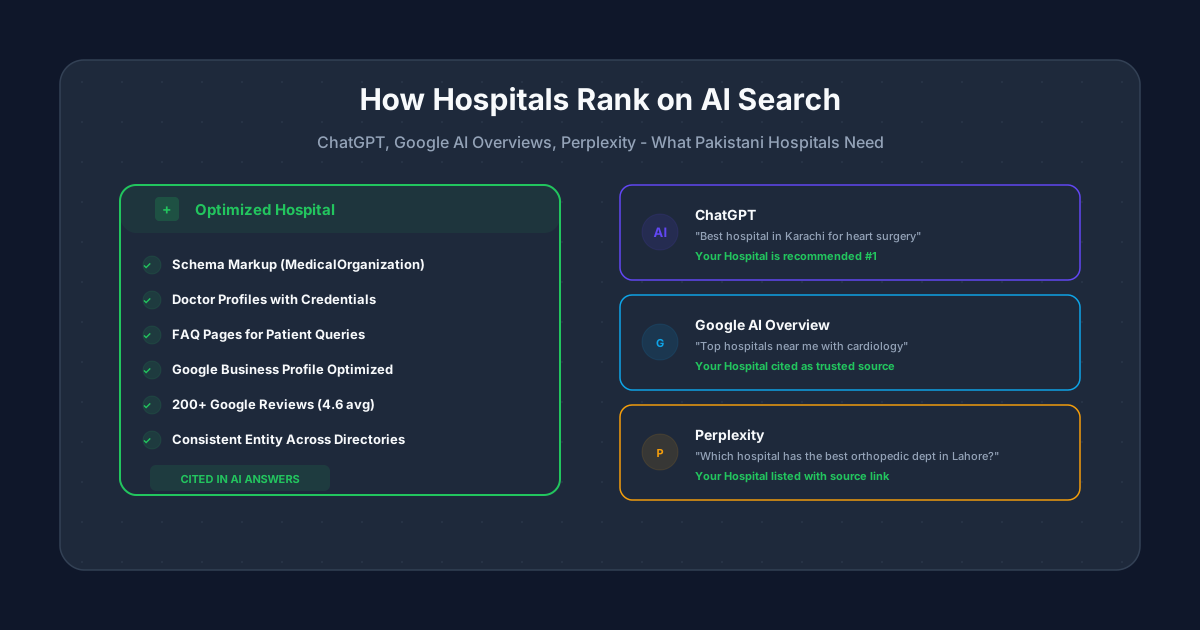
A patient in Karachi opens ChatGPT on their phone and types: 'Which hospital in Karachi is best for heart bypass surgery?' Within seconds, ChatGPT lists three hospitals with brief descriptions of their cardiology departments, doctor credentials, and patient review summaries. That patient picks one and books a consultation. They never opened Google. They never scrolled through ten blue links. They asked an AI, got an answer, and acted on it. This is happening right now, thousands of times a day across Pakistan. The question every hospital administrator, marketing director, and healthcare entrepreneur should be asking is simple: when a patient asks AI about your speciality in your city, does your hospital appear in the answer? If not, this guide will show you exactly how to change that.
Why AI Search Matters for Pakistani Hospitals Right Now
The shift is not theoretical. Pakistani patients are already using AI platforms to make healthcare decisions. A mother searching for 'best pediatrician in Lahore' on ChatGPT gets a direct recommendation, not a list of websites to visit. A patient researching knee replacement options asks Perplexity and receives a comparison of hospitals with success rates and cost ranges. Google itself now shows AI Overviews at the top of health-related searches, pushing traditional organic results below the fold.
For hospitals, this changes the competitive landscape fundamentally. Ranking on page one of Google used to be enough. Now there is a layer above Google results that patients see first. If your hospital is not the one AI platforms cite, you are losing patients to competitors who are optimized for this new reality. The hospitals that move first will capture patient demand that competitors do not even realize they are losing.
How AI Platforms Decide Which Hospitals to Recommend
AI platforms do not randomly pick hospitals to mention. They pull information from specific sources and rank it using specific signals. Understanding these signals is the foundation of Answer Engine Optimization (AEO) for hospitals. Here is what ChatGPT, Google AI Overviews, and Perplexity actually look at when a patient asks for hospital recommendations.
Structured Data and Schema Markup
Structured data is the most direct way to communicate with AI platforms. When your hospital website has MedicalOrganization, Hospital, Physician, and MedicalClinic schema markup properly implemented, AI platforms can instantly understand what your hospital does, which departments you have, who your doctors are, what insurance you accept, and where you are located. Without structured data, AI platforms have to guess from unstructured text on your website, and they often guess wrong or skip you entirely.
Most Pakistani hospital websites have zero structured data. The few that do usually have basic LocalBusiness schema that does not tell AI platforms anything about medical specialties, doctor credentials, or available procedures. This is a massive opportunity. The first hospitals in each city to implement comprehensive medical schema markup gain a significant advantage in AI search citations.
Online Reviews and Reputation Signals
When a patient asks ChatGPT 'best hospital in Islamabad,' AI weighs review volume, average rating, and review recency heavily. A hospital with 500 Google reviews averaging 4.5 stars is far more likely to be cited than a hospital with 30 reviews averaging 3.8 stars. The review content itself matters too. AI platforms extract specific information from review text: mentions of doctor names, department quality, wait times, cleanliness, and staff behaviour.
Pakistani hospitals typically underinvest in review generation. Many excellent hospitals have fewer than 100 Google reviews simply because they never ask satisfied patients to leave feedback. Building a systematic review generation process is one of the highest-impact AEO activities a hospital can undertake.
Entity Consistency Across the Web
AI platforms build an understanding of your hospital as an entity by cross-referencing information across dozens of sources: your website, Google Business Profile, healthcare directories, social media profiles, government health registrations, and news mentions. If your hospital name, address, phone number, department listings, or doctor names are inconsistent across these sources, AI platforms lose confidence in the information and are less likely to cite you.
A common problem with Pakistani hospitals: the Google Business Profile says 'City Hospital Karachi,' the website says 'City Hospital and Medical Centre,' the Facebook page says 'City Hospital Pvt Ltd,' and the PMDC listing shows yet another variation. AI platforms see four different entities instead of one authoritative hospital. Fixing this inconsistency is foundational to AEO.
Content Authority and Medical Expertise
AI platforms prioritize hospitals that demonstrate genuine medical expertise through their online content. A hospital website that publishes detailed department pages, doctor profiles with credentials and specializations, procedure explanations written by actual physicians, and patient education resources gets cited far more often than a hospital with a five-page brochure website.
This is not about blogging for the sake of blogging. It is about creating the specific content that AI platforms need to confidently recommend your hospital for specific medical queries. When a patient asks 'which hospital in Lahore does robotic knee replacement,' AI can only answer accurately if a hospital in Lahore has published detailed, authoritative content about their robotic knee replacement programme.
Step-by-Step: Getting Your Hospital Cited in ChatGPT
ChatGPT draws from its training data, web browsing capabilities, and indexed content. Here is how to ensure your hospital is part of the information ChatGPT uses when answering patient queries about hospitals in your city.
1. Build Comprehensive Department Pages
Create a dedicated page for every major department and medical specialty your hospital offers. Each department page should include the department name and a clear description of what it treats, the lead physicians with their qualifications and years of experience, a list of procedures and treatments available, any specialized equipment or technology the department uses, and FAQs that patients commonly ask about that specialty.
For example, your Cardiology department page should not be a paragraph saying 'We offer excellent cardiac care.' It should name your cardiologists, list whether you perform angioplasty, bypass surgery, pacemaker implantation, and echocardiography, mention your catheterization lab capabilities, and answer questions like 'How much does angioplasty cost in [your city]?' and 'What is the recovery time for bypass surgery?'
2. Create Individual Doctor Profile Pages
Every physician at your hospital should have a dedicated profile page with their full name and photograph, medical qualifications (MBBS, FCPS, MRCP, etc.), specialization and sub-specialization, years of experience, hospital affiliations, published research or academic contributions if any, languages spoken, and consultation hours and booking information.
Implement Physician schema markup on each doctor profile page. This tells AI platforms exactly who practices at your hospital, what their credentials are, and what conditions they treat. When a patient asks ChatGPT 'best cardiologist in Karachi,' the AI needs structured physician data to provide a confident answer.
3. Implement Medical Schema Markup Across Your Website
Schema markup is the technical implementation that makes all your content readable by AI platforms. For hospitals, the critical schema types are Hospital and MedicalOrganization for the main entity, MedicalClinic for individual departments or branch clinics, Physician for each doctor, MedicalProcedure for treatments and surgeries, FAQPage for patient questions, and LocalBusiness with medical-specific properties.
Each schema type should include as many properties as you can accurately fill. The more detailed and accurate your schema, the more confident AI platforms are when citing your hospital. This is not something your website developer can rush through in an hour. It requires careful mapping of your hospital's actual services, departments, and physicians to the correct schema properties. A professional AEO agency can handle this implementation properly.
4. Build a Patient FAQ Knowledge Base
AI platforms love FAQ content because it directly maps to how patients ask questions. Create FAQ sections on every department page and procedure page. Also create standalone FAQ pages for common patient concerns. Think about the questions patients ask your front desk and your doctors every day. Those are the exact questions patients are now asking ChatGPT instead.
- 'How much does [procedure] cost at [hospital name]?' - Include honest cost ranges where possible.
- 'Is [doctor name] good for [condition]?' - Your doctor profiles with credentials and patient reviews answer this.
- 'What insurance does [hospital name] accept?' - Create a dedicated insurance and payment page.
- 'What are visiting hours at [hospital name]?' - Include this in your LocalBusiness schema and on a dedicated page.
- 'Does [hospital name] have emergency services?' - Detail your emergency department capabilities.
- 'How do I book an appointment at [hospital name]?' - Clear booking instructions with online booking if available.
5. Optimize Your Google Business Profile for AI
Your Google Business Profile is one of the primary data sources AI platforms use for local hospital information. An incomplete or inaccurate profile directly reduces your AI search visibility. Ensure your profile has the correct primary category (Hospital, Medical Center, or specific specialty), all secondary categories that apply to your departments, complete and accurate business hours including emergency hours, a detailed business description mentioning your key departments and specialties, high-quality photos of your facility updated regularly, all services listed individually, and the Q&A section actively managed with accurate answers.
Post regularly on your Google Business Profile. Share health awareness content, new department launches, doctor achievements, and patient education material. Active profiles signal to both Google and AI platforms that your hospital is an engaged, current healthcare provider.
6. Get Listed on Healthcare Directories
AI platforms cross-reference hospital information across directories. Being listed on Marham.pk, oladoc.com, Healthwire.pk, and other Pakistani healthcare platforms with consistent information strengthens your entity signals. Each listing should have the exact same hospital name, address, phone number, and department information as your website and Google Business Profile.
International directories matter too. Listings on Practo, Healthgrades, and similar platforms add global authority signals that AI platforms recognize. If your hospital serves medical tourism patients, these international listings become even more important.
Getting Your Hospital Into Google AI Overviews
Google AI Overviews appear at the top of Google search results for health-related queries. They pull information from web pages that Google considers authoritative for that specific query. To appear in AI Overviews, your content needs to be the most clearly structured, most authoritative, and most directly relevant answer to the patient's query.
- Write content that directly answers specific medical questions in the first paragraph, then expands with detail below. Google AI Overviews extract the direct answer.
- Use proper heading hierarchy (H2 for departments, H3 for procedures) so Google can parse your page structure.
- Include comparison content: 'Cost of angioplasty in Karachi: Hospital A vs Hospital B' style content often appears in AI Overviews.
- Publish procedure cost ranges. Patients search for costs constantly, and hospitals that publish honest ranges get cited in AI Overviews more than those that hide pricing.
- Update content regularly. Google AI Overviews favor fresh, recently updated content over stale pages that have not changed in years.
Getting Your Hospital Cited on Perplexity
Perplexity works differently from ChatGPT and Google AI Overviews. It performs real-time web searches and cites specific source URLs in its answers. This means Perplexity citations drive actual website traffic, not just brand mentions. To get cited on Perplexity, your hospital website needs to rank well on traditional search and have clearly structured content that Perplexity can extract and attribute.
The most effective strategy for Perplexity is creating detailed, factual content pages that answer specific medical questions comprehensively. Perplexity looks for pages that it can cite as a source, so your content needs to be original, authoritative, and directly relevant to health queries Pakistani patients actually ask. Doctor profiles, department capability pages, and procedure guides with costs are the content types Perplexity cites most for hospital queries.
The Review Strategy That Powers AI Citations
Reviews are not just social proof. They are data that AI platforms use to rank and recommend hospitals. A hospital with recent, detailed, positive reviews across Google, Facebook, and healthcare directories has a massive AEO advantage. Here is how to build a review engine that directly feeds AI visibility.
- 1.Train reception and discharge staff to ask satisfied patients to leave a Google review. Timing matters. Ask when the patient expresses gratitude, not when they are rushing to leave.
- 2.Send a follow-up SMS or WhatsApp message 24 hours after discharge with a direct link to your Google review page. Make it one tap to leave a review.
- 3.Respond to every review, positive and negative. AI platforms see engaged response patterns as a trust signal. A hospital that responds to reviews appears more credible than one that ignores them.
- 4.Never buy fake reviews. AI platforms are trained to detect review patterns that indicate manipulation, and getting caught destroys your credibility across all AI platforms simultaneously.
- 5.Encourage specific reviews. Instead of 'Please rate us,' ask 'Would you share your experience with Dr. [name] and our [department] team?' Specific reviews contain the keywords and entity mentions AI platforms extract.
Common Mistakes Pakistani Hospitals Make With AI Search
Working with healthcare clients across Pakistan, we see the same AEO mistakes repeatedly. Avoiding these will put your hospital ahead of 90% of competitors.
- Brochure websites with five pages. A hospital website needs 50 to 200 pages to adequately cover all departments, doctors, procedures, and patient information. Five pages tell AI nothing useful.
- No schema markup at all. The website looks fine to humans but is invisible to AI crawlers that depend on structured data to understand medical entities.
- Doctor names only on PDFs. If your doctor directory is a downloadable PDF, AI platforms cannot read it. Doctor information must be on crawlable HTML pages.
- Inconsistent naming across platforms. 'ABC Hospital,' 'ABC Hospital Pvt Ltd,' 'ABC Medical Centre' across different directories confuses AI entity recognition.
- No FAQ content. The questions patients ask on the phone are the same questions they type into ChatGPT. Without FAQ pages, you have no content for AI to cite.
- Ignoring Google Business Profile. Outdated hours, missing departments, no photos, no posts. This is often the first data source AI platforms check for local hospital information.
- No cost information anywhere. Pakistani patients actively search for procedure costs. Hospitals that publish honest cost ranges get cited in AI answers. Those that hide pricing get skipped.
Measuring Your Hospital's AI Search Visibility
You cannot improve what you do not measure. Here is how to track whether your AEO efforts are actually working.
- Manually test ChatGPT, Perplexity, and Google AI with queries patients would use: 'best [specialty] hospital in [your city],' 'top [procedure] surgeon in [your city],' '[your hospital name] reviews.' Document whether your hospital appears and in what position.
- Track Google Business Profile insights: views, searches, calls, direction requests, and website clicks. These metrics show whether local search visibility is growing.
- Monitor Google Search Console for impressions and clicks on department pages, doctor profile pages, and FAQ pages. Growing impressions on medical queries means AI platforms are more likely to find and cite your content.
- Track new patient acquisition source. Ask new patients how they found your hospital. An increasing percentage saying 'I asked ChatGPT' or 'I saw it on Google' validates your AEO investment.
- Use a professional AEO monitoring service to systematically track AI citations across platforms over time.
Which Hospitals Should Invest in AEO First?
Every hospital benefits from AI search optimization, but some will see faster and larger returns than others. Hospitals in competitive urban markets like Karachi, Lahore, and Islamabad benefit most because patient search volume on AI platforms is highest in these cities. Hospitals with strong clinical reputations but weak online presence benefit dramatically because AEO bridges the gap between real-world quality and digital visibility.
Specialty hospitals and centres of excellence have a particular advantage. A hospital known for cardiac surgery, oncology, or orthopedics can dominate AI search for those specific specialties faster than general hospitals can dominate broad queries. The more specialized and specific your content, the easier it is for AI platforms to match it to patient queries.
New hospitals and recently expanded facilities should build AEO into their launch strategy from day one. It is far easier to launch with proper schema markup, comprehensive content, and a review generation system than to retrofit these elements onto a neglected website later.
The Cost of Waiting
AI search adoption among Pakistani patients is accelerating. Every month you wait, competitors build more reviews, publish more content, implement better schema markup, and strengthen their entity signals. AI platforms develop preferences based on historical data. A hospital that has been consistently cited in AI answers for six months builds a compounding advantage that is progressively harder for late arrivals to overcome.
The hospitals that invest in AEO now will own the AI search landscape in their cities for years. The hospitals that wait will spend significantly more to catch up later, if they can catch up at all. This is not a trend to watch. It is a patient acquisition channel that is already active and growing.