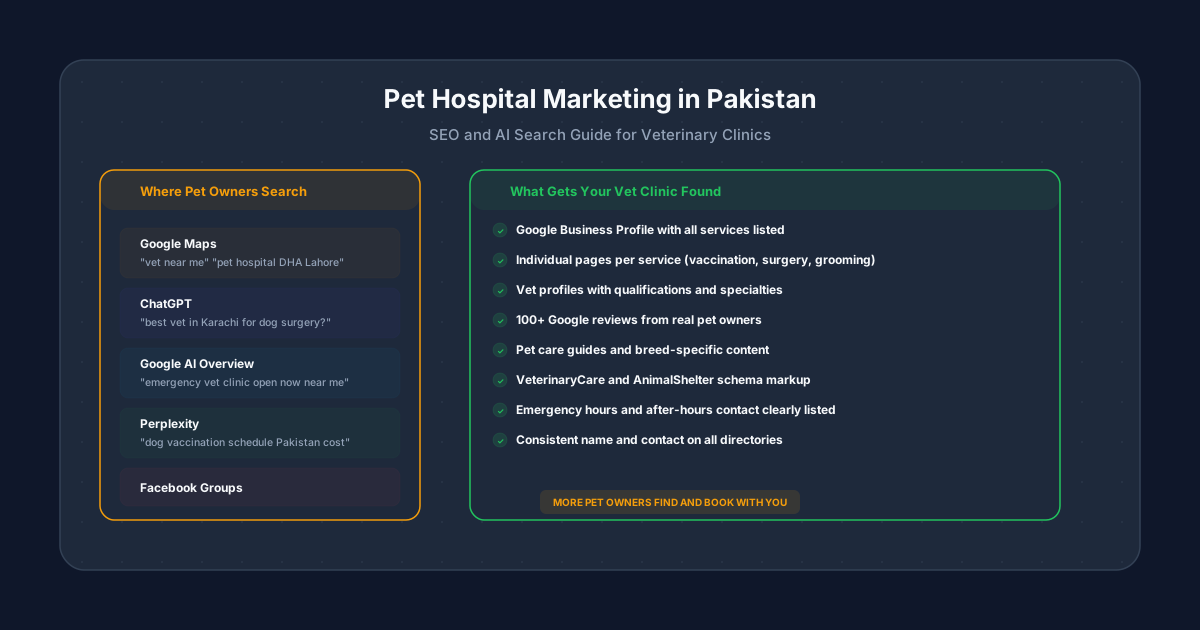
Here is something that catches a lot of vet clinic owners off guard. A pet owner in Lahore whose cat is sick does not call around asking friends for a vet anymore. They pull out their phone, open Google Maps, and type 'vet near me.' Or they open ChatGPT and ask 'which is the best pet hospital in Lahore for cat surgery?' And just like that, within seconds, they have a shortlist. If your clinic is not on that shortlist, you never existed in that pet owner's world. Pakistan's pet care industry has exploded over the last few years. Dog ownership is way up, cat cafes are opening in Islamabad, exotic pet owners are importing specialized food online. But here is the gap: most pet hospitals and vet clinics in Pakistan still rely on word of mouth and a Facebook page for marketing. Meanwhile, pet owners have moved to Google and AI search. This guide is for vet clinic owners who want to close that gap. No jargon, no fluff. Just what actually works to get pet owners finding and booking with your clinic.
How Pet Owners in Pakistan Actually Find a Vet
Forget what you think you know about how people find vets. The reality in 2026 looks nothing like it did even three years ago. Roughly 60% of new patient visits at urban vet clinics now start with a Google search. That number keeps climbing. And it breaks down into a few patterns worth understanding because each one needs a slightly different approach from your side.
The first and biggest channel is Google Maps. Someone types 'vet near me' or 'pet hospital in DHA Karachi' and sees three clinics on the map with ratings, hours, and a call button. Most people pick from those three. They do not scroll down to the organic results. They do not visit websites. They look at the rating, read two or three reviews, and call. If your clinic is not in those top three map results for your area, you are invisible to the majority of pet owners searching right now.
The second channel is growing fast: AI search. Pet owners are asking ChatGPT things like 'which vet in Islamabad is good for parrot treatment' or 'best emergency vet clinic in Karachi open on Sunday.' Google itself is showing AI Overviews at the top of pet-related searches, giving direct recommendations before anyone even sees the regular results. Perplexity is doing the same, pulling from the web and citing specific vet clinics by name. This is newer, but it is not niche anymore. Younger pet owners especially are going straight to AI for recommendations.
The third channel is still Facebook groups. Pakistani pet owner communities on Facebook are massive. Someone posts 'can anyone recommend a good vet in Gulberg?' and gets twenty replies. You cannot directly optimize for this, but here is the connection: when someone recommends your clinic in a Facebook group, the first thing the person asking does is Google your clinic name. If your Google profile is incomplete, has few reviews, or your website looks like it was built in 2015, you lose the patient even after getting a personal recommendation.
Your Google Business Profile Is Your Most Valuable Marketing Asset
I cannot stress this enough. For a vet clinic, your Google Business Profile matters more than your website, more than your social media, more than anything else online. It is the first thing pet owners see. It is what AI platforms reference. It is where reviews live. And the sad truth is that most vet clinics in Pakistan have barely filled theirs out.
Go look at your Google Business Profile right now. Seriously, Google your clinic name and look at what shows up. Are your hours correct? Do you have your emergency and after-hours availability listed? Are all your services listed individually, or is it just 'veterinary services' as a single category? Do you have photos from the last six months, or are you still showing that one blurry photo from 2021? Is your phone number a WhatsApp-enabled number that actually gets answered?
- Set your primary category to 'Veterinarian' or 'Animal Hospital.' Not 'Pet Store,' not 'Medical Center.' The category matters because Google uses it to decide which searches to show you for.
- Add every secondary category that fits: 'Emergency Veterinarian,' 'Pet Groomer,' 'Animal Boarding,' 'Pet Supply Store' if you sell supplies.
- List every single service individually. Not 'veterinary services.' List: dog vaccination, cat spay/neuter, pet surgery, dental cleaning, X-ray/radiology, microchipping, deworming, tick and flea treatment, pet boarding, grooming. Each one you list is another search query Google can match you to.
- Upload real photos every month. Your clinic interior, treatment rooms, boarding area, happy pets with their owners (with permission). Clinics with 20+ photos get dramatically more profile views than those with 5 or fewer.
- Post on your profile weekly. Share a pet health tip, announce a vaccination drive, post about a successful surgery (no graphic images). Google rewards active profiles with better visibility.
- Answer the Q&A section. Add your own frequently asked questions and answer them. Do you treat exotic pets? What are your emergency hours? Do you offer home visits? Put these answers there before random people add wrong information.
Why You Need a Real Website (Not Just Social Media)
A lot of vet clinic owners in Pakistan think their Facebook page is enough. It is not. Facebook limits what Google can see. Facebook does not let you add schema markup. Facebook does not let you create individual service pages. Facebook does not let you build the kind of structured, authoritative content that AI platforms need to recommend you. Your Facebook page is fine for community engagement, but it cannot do the heavy lifting of search visibility.
Your website does not need to be fancy. It does not need animations or a custom design that cost millions. It needs to be fast on mobile, have clear information, and have individual pages for the things pet owners actually search for. That is it. A clean, well-organized website with solid content beats a flashy one with no substance every single time.
Pages Your Vet Clinic Website Needs
Think of each page as answering one specific question a pet owner might type into Google or ask ChatGPT. The more specific questions you answer, the more searches you show up for.
- Homepage with your clinic name, location, hours, and a clear call-to-action to book or call.
- Individual service pages: vaccination, surgery, dental, boarding, grooming, emergency care, each on its own page with details, what to expect, and approximate costs.
- Vet profiles: every veterinarian at your clinic with their name, photo, qualifications, specialties, and experience. A pet owner wants to know who will be treating their animal.
- Pet care guides: simple, helpful articles about common pet concerns. 'Dog vaccination schedule in Pakistan,' 'how to tell if your cat needs emergency care,' 'common skin problems in Pakistani stray dogs.' This content brings pet owners to your website through search and builds your authority.
- Emergency information page: what qualifies as a pet emergency, your emergency hours, your emergency contact number, what to do while getting to the clinic. Pet owners desperately search for this and most vet clinic websites do not have it.
- Contact and location page: address with Google Maps embed, phone number, WhatsApp link, directions from major landmarks, parking information.
- Pricing or cost information page: even approximate ranges help. Pet owners in Pakistan heavily search for treatment costs before booking.
Getting Your Clinic Recommended by ChatGPT and AI Search
This is the part most vet clinics have not even thought about yet. When a pet owner asks ChatGPT 'best vet in Karachi' or 'where should I take my dog for surgery in Lahore,' the AI does not just make something up. It looks for signals. It checks your website content, your Google reviews, your presence on directories, whether your information is consistent everywhere, and how authoritative your online presence looks.
The clinics that show up in AI answers right now are mostly the ones that, intentionally or not, have done a good job with the basics: lots of real reviews, a detailed website, consistent information across the internet. But very few vet clinics in Pakistan have done this intentionally. Which means there is a real window right now to get ahead. If you are one of the first vet clinics in your city to deliberately optimize for AI search, you will own those recommendations while your competitors are still wondering what happened.
What AI Platforms Look At When Recommending Vets
- Review volume and quality on Google. A clinic with 150 reviews and a 4.5 rating will get recommended over one with 12 reviews and a 4.8 rating. AI trusts volume.
- Detailed website content about specific treatments and services. A page about 'dog ACL surgery at [clinic name]' gives AI something concrete to cite. A bullet point on a services page does not.
- Vet credentials published on your website. Names, degrees, specializations. AI cannot recommend a specific vet if it cannot find their information.
- Consistent clinic name, address, and phone across your website, Google, Facebook, and directory listings. Inconsistency confuses AI into thinking there are multiple different businesses.
- Freshness. Recently updated websites and recently posted Google Business Profile updates signal that the business is active and current.
- Directory presence. Being listed on PakVet, local business directories, and pet community platforms adds cross-referencing signals.
The Review Game: How to Build a Review Engine for Your Vet Clinic
Let me be blunt about this. If your vet clinic has fewer than 50 Google reviews, that is your number one marketing priority right now. Not a new website, not social media ads, not a blog. Reviews. Everything else builds on top of them. Reviews drive your Google Maps ranking. Reviews are the first thing pet owners check. Reviews are what AI platforms reference when deciding which clinics to recommend. And most vet clinics in Pakistan have somewhere between 5 and 30 reviews, which is nowhere near enough.
The good news: getting more reviews is not complicated. It just requires a system. Most pet owners who had a positive experience will happily leave a review. They just need to be asked. The problem is that most clinics never ask.
- 1.Create a short link to your Google review page. Use a URL shortener or a QR code. Both work. The goal is making it one tap for the pet owner.
- 2.Print small cards with the QR code and a simple message like 'Loved your visit? Help other pet parents find us' and hand them to clients as they leave after a successful appointment.
- 3.Send a WhatsApp message 2 to 3 hours after the appointment. Something simple: 'Hi [name], we hope [pet name] is doing well after today's visit. If you have a moment, a Google review really helps other pet owners find us: [link].' Keep it personal, not corporate.
- 4.Train your reception staff and vet assistants to ask at the right moment. The right moment is when the pet owner is smiling and relieved, usually right after you tell them their pet is going to be fine. Not when they are paying or rushing out.
- 5.Respond to every review. Every single one. Thank the happy ones by mentioning the pet's name if they did. Address the unhappy ones calmly and professionally with a genuine offer to fix the issue. Your responses are being read by every future pet owner who checks your reviews. And AI reads them too.
Service Pages That Actually Bring In Pet Owners
Here is where most vet clinic websites fall apart. They have one 'Services' page that lists everything in bullet points: 'Vaccination, Surgery, Grooming, Boarding, Dental.' That is useless for search. Google cannot rank that page for 'dog vaccination in Karachi' because there is no real content about vaccinations specifically. AI cannot cite your clinic for surgery expertise because there is nothing to cite.
Each major service needs its own page. It does not need to be 3,000 words. 500 to 800 words of genuinely useful information is plenty. Here is what to include on a service page for, say, pet vaccination:
- What vaccinations you offer (list them: rabies, DHPP, feline distemper, etc.).
- The vaccination schedule for puppies and kittens, and the adult booster schedule.
- What happens during a vaccination visit at your clinic (so first-time pet owners know what to expect).
- Approximate cost range. Yes, put the price. Pet owners search for 'dog vaccination cost in Pakistan' constantly. If your page has the answer, that pet owner lands on your website.
- Which vet handles vaccinations and their qualifications.
- FAQs: 'Is the rabies vaccine mandatory in Pakistan?' 'Can I vaccinate a pregnant cat?' 'What are the side effects?' Answer the questions your staff gets asked ten times a week.
Schema Markup: The Technical Bit That Makes a Big Difference
Schema markup is code you add to your website that tells Google and AI platforms exactly what your clinic is, what services you offer, who your vets are, and where you are located. Think of it as a structured summary of your business that search engines can read instantly without trying to figure it out from your page text.
Most vet clinic websites in Pakistan have zero schema. Adding it is like going from invisible to highlighted in the search engine's eyes. Your web developer can implement these in a few hours. If you do not have a developer, a pet hospital SEO service can handle it.
- VeterinaryCare schema for each service page, describing the treatment and which vet performs it.
- LocalBusiness or AnimalHospital schema on your homepage with your clinic name, address, geo-coordinates, phone, hours, and service area.
- Person schema for each vet with their name, credentials, and role.
- FAQPage schema on any page with Q&As. This makes your FAQs eligible for Google's rich results, which take up more space in search and get more clicks.
Emergency Vet Searches: A Massive Opportunity Most Clinics Miss
Emergency pet searches are some of the highest-intent searches in veterinary care. A pet owner whose dog just ate something toxic is not casually browsing. They need a vet right now. And they are going to call the first clinic they find that looks open and capable. These searches are things like 'emergency vet near me,' 'vet open now in Karachi,' '24 hour pet hospital Lahore,' and 'my dog ate chocolate what do I do Pakistan.'
Most vet clinics in Pakistan that offer emergency services do a terrible job of making that visible online. Their Google profile does not show emergency hours. Their website does not have an emergency page. They do not rank for emergency searches because they have never created content around it.
If your clinic handles emergencies, you need a dedicated emergency page on your website that clearly states your emergency hours, your emergency contact number (ideally a different number that is always monitored), what counts as a pet emergency, what to do while getting to the clinic, and what emergency services you offer (poison treatment, emergency surgery, trauma care, etc.). Add this information to your Google Business Profile too. And make sure your emergency hours are correct and updated for holidays and Ramadan.
Content That Pet Owners Actually Search For
You do not need to become a blogger. But a handful of well-written pet care guides on your website will bring in a steady stream of pet owners through search. The trick is writing about the things pet owners in Pakistan actually look up. Not general pet trivia, but specific concerns they have about their animals. Here are the kinds of topics that consistently bring traffic to vet clinic websites:
- 'Dog vaccination schedule in Pakistan' - one of the most searched pet health queries in the country. A clear, accurate guide with your recommended schedule brings pet owners to your site who are ready to book vaccinations.
- 'Cat not eating for 2 days' or 'dog vomiting yellow' - pet owners panic-search symptoms. A helpful page that explains when to worry and when to visit a vet positions your clinic as the obvious choice.
- 'Best dog food brands available in Pakistan' - massive search volume. A genuine, helpful guide (not a sales pitch) builds trust and brings pet owners to your site.
- 'Tick and flea treatment for dogs in Pakistan' - seasonal spike searches during summer. A practical guide with treatment options you offer converts readers into patients.
- 'How much does pet surgery cost in Pakistan' - cost content has huge search volume and directly attracts pet owners who are about to make a booking decision.
- 'Persian cat care guide' or 'German Shepherd health problems' - breed-specific content attracts owners of those breeds who are looking for a vet who understands their pet.
What Not to Waste Your Time On
Not everything marketed to vet clinics as 'digital marketing' is worth doing. Here is what to skip so you can focus on what actually moves the needle.
- Paid Instagram followers. Vanity numbers that do not convert to appointments. Waste of money.
- Generic SEO agencies that treat your vet clinic like any other small business. Veterinary marketing has specific requirements around medical content quality, local search behaviour, and industry directories. A generic agency will not understand these.
- Blogging about topics nobody searches for. 'Five fun facts about hamsters' is not bringing anyone to your clinic. Write about what pet owners actually Google.
- A website redesign before fixing your Google Business Profile and reviews. The profile and reviews drive 10 times more patient calls than your website. Fix those first.
- Running Google Ads without having your organic foundation in place. Ads can work, but they are expensive and stop working the second you stop paying. Build your organic and AI search visibility first, then add ads on top if you want to accelerate.
The Priority Checklist for This Month
If you take nothing else from this guide, do these five things in the next 30 days. They will have more impact on your patient bookings than anything else you could spend your marketing budget on.
- 1.Spend two hours completing your Google Business Profile. All services listed individually, correct hours including emergency hours, 15+ real photos, your top 10 FAQs in the Q&A section. This single action will improve your local visibility more than any other.
- 2.Set up a review generation system. QR code cards, WhatsApp follow-up template, staff training. Set a goal of 10 new reviews this month. Then 10 more next month. And the month after that.
- 3.Create three service pages on your website for your highest-demand services. Vaccination, general surgery, and one more that you are known for. Each page: 500-800 words, cost information, vet name with qualifications, 5 FAQs.
- 4.Check your clinic's name, address, and phone number on Google, Facebook, and any directories you are listed on. Make them identical everywhere. One inconsistency is one opportunity for Google and AI to get confused about who you are.
- 5.Test yourself on ChatGPT. Ask 'best vet in [your city]' and 'pet hospital in [your area].' See who comes up. That is your competition. That is what you are working to beat.
The Clinics That Move First Will Win
Pakistan's pet industry is growing, and the number of people searching online for veterinary care is growing even faster. But the number of vet clinics that have their online presence properly sorted is still tiny. In most cities, you can count on one hand the vet clinics with a complete Google profile, strong reviews, and a website that actually helps pet owners find what they need.
That will not last. As the industry matures, more clinics will catch on. The ones that build their online presence now, while the competition is still asleep, will have a head start that is genuinely hard to close. Six months of reviews, six months of content building authority, six months of AI platforms learning to trust and recommend your clinic. That compounding advantage is real, and it starts with the actions you take this month. If you want help getting it done right, a veterinary SEO and AEO service can handle the technical work while you focus on treating animals.