I want to tell you about a pattern I keep seeing with physiotherapy clinics in Pakistan. A physio opens a clinic. They are qualified, experienced, maybe even trained abroad. They do great work. Patients who find them are happy. But the clinic stays half empty because not enough new patients are walking through the door. The physio blames it on the market, on people not valuing physiotherapy, on competition. But the real problem is much simpler: patients cannot find them. Here is what is actually happening. A cricket player in Lahore pulls a muscle during a weekend match. He opens Google Maps and searches 'physiotherapist near me.' Three clinics pop up. He picks the one with the best reviews and calls them. He does not know your clinic exists because it was not in those three results. Or take another example. A woman in Karachi has been dealing with chronic back pain for months. She asks ChatGPT: 'best physiotherapy clinic for back pain in Karachi.' ChatGPT gives her three or four names based on what it can find online. Your clinic is not mentioned because your online presence is thin. She books with someone else. This is happening hundreds of times a day across Pakistan. The physiotherapy market here is growing fast. More people are aware of physiotherapy than ever before. Sports injuries, post-surgery rehab, chronic pain management, workplace injuries -- the demand is real. But the patients are going to whoever shows up when they search, not necessarily to whoever is the best therapist.
How Patients in Pakistan Find a Physiotherapist
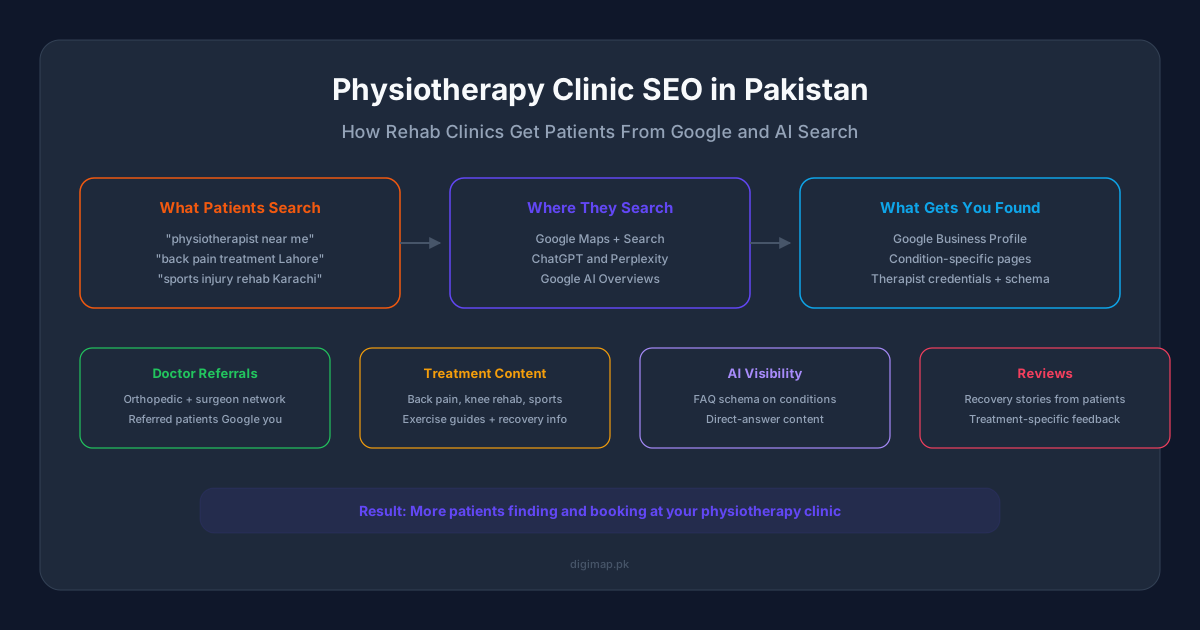
The way people find a physiotherapist in Pakistan has changed completely, and most physio clinic owners have not caught up yet. Understanding these search patterns is the first step to getting more patients.
The biggest referral channel is still doctors. Orthopedic surgeons, sports medicine doctors, and general physicians refer patients to physio all the time. But here is the part most physiotherapists miss: even when a doctor refers a patient to your specific clinic by name, the patient almost always Googles your clinic before booking. They check your reviews, look at photos of your clinic, maybe look at your website. If your Google presence is weak, you lose patients who were literally referred to you. That is how important your online presence is.
The second channel is Google Maps. People searching 'physiotherapist near me,' 'physio clinic in Gulberg,' or 'sports physiotherapy DHA Karachi.' Google shows three clinics on the map with ratings and a call button. For most physiotherapy searches, patients pick from those three. They do not scroll to the fourth result. They do not open a second tab.
The third channel is condition-based Google searches. 'Back pain treatment in Lahore,' 'frozen shoulder physiotherapy Islamabad,' 'ACL rehab clinic Karachi.' These are patients who know what is wrong with them and are looking for someone who specifically treats that condition. Your website content wins these searches.
The fourth and fastest growing channel is AI search. People asking ChatGPT 'which is the best physio for sports injuries in Lahore' or Google showing AI Overviews at the top of physiotherapy searches. AI platforms pull from the entire web and recommend clinics that have strong, consistent online information. This is new territory, and the physio clinics that get in early will have a significant advantage.
Your Google Business Profile Is Your Reception Desk Online
Think of your Google Business Profile as your online reception desk. It is the first thing most potential patients see. And just like a messy, unstaffed reception desk would turn patients away from your physical clinic, an incomplete Google profile turns them away before they ever call you.
Go Google your clinic name right now. What comes up? Do you even have a Google Business Profile? Is the phone number correct? Are your hours right? Do you have more than one blurry photo? Have you listed all the conditions you treat?
- Set your primary category to 'Physical Therapy Clinic' or 'Physiotherapist.' This is the most important single setting. If your category is wrong, you will not appear for physiotherapy searches.
- Add relevant secondary categories: 'Sports Medicine Clinic,' 'Rehabilitation Center,' 'Chiropractor' if you offer chiropractic services, 'Massage Therapist' if you do therapeutic massage.
- List every treatment and condition as a service. Do not just write 'physiotherapy.' List: back pain treatment, neck pain treatment, sports injury rehabilitation, ACL reconstruction rehab, frozen shoulder treatment, sciatica treatment, stroke rehabilitation, post-surgery rehabilitation, workplace injury rehab, pediatric physiotherapy, geriatric physiotherapy, dry needling, cupping therapy, electrotherapy, ultrasound therapy, shockwave therapy. Every service is a search query.
- Upload photos of your treatment rooms, equipment, and team. Show your parallel bars, your treatment beds, your exercise equipment, your electrotherapy machines. Patients want to see a professional, well-equipped clinic. Upload new photos every two weeks.
- Post on your Google profile regularly. Share a quick tip about posture, announce a new service, post about a patient recovery story with their permission. Active profiles rank better.
Building a Website That Ranks for Condition Searches
Here is where physiotherapy clinics have a massive opportunity that most are completely ignoring. People search for conditions, not just for physiotherapists. They search 'back pain treatment in Karachi' or 'frozen shoulder exercises' or 'how long does ACL rehab take.' If your website has dedicated pages for the conditions you treat, you can capture all of that search traffic.
Most physio clinic websites I see in Pakistan are one page with a list of services in bullet points. That will never rank for anything. You need individual pages for each major condition you treat.
- Create a dedicated page for each condition you commonly treat. Back pain, neck pain, sciatica, frozen shoulder, knee pain, ACL injuries, rotator cuff injuries, tennis elbow, carpal tunnel, stroke rehabilitation, post-surgery rehab, sports injuries. Each page should be 800 to 1,200 words.
- Each condition page should cover: what the condition is, common causes, symptoms to watch for, how physiotherapy helps, what a typical treatment plan looks like at your clinic, how many sessions patients usually need, what exercises or home care you recommend alongside treatment.
- Include your city name naturally. 'Back pain treatment in Lahore' should appear in your page title, your main heading, and once or twice in the content. Not stuffed everywhere, just naturally present.
- Add a clear call to action on every condition page. A phone number, a WhatsApp button, or a booking form. Someone reading your page about frozen shoulder treatment is a patient who needs frozen shoulder treatment. Make it easy for them to book.
- Include your therapists' credentials on the website. DPT, MS in physiotherapy, certifications in dry needling or sports rehab, years of experience. This builds trust with patients and is a strong signal for Google's health content evaluation.
Getting Your Clinic Recommended by AI Platforms
AI search is a goldmine for physiotherapy clinics, and almost nobody in Pakistan is optimizing for it yet. When someone asks ChatGPT 'best physio clinic for back pain in Islamabad,' the AI has to find information to build its answer. If your clinic has detailed, clear, well-structured information available online, you become a source it can confidently cite.
The key to AI visibility is not some special trick. It is about having consistent, accurate, detailed information across multiple sources. AI platforms cross-reference. They check if your Google profile matches your website, if your listed services are consistent, if your credentials are verifiable.
- Write content that directly answers patient questions. Not marketing copy. Direct answers. 'How much does physiotherapy cost in Lahore?' Answer it on your website: 'At [clinic name], a physiotherapy session typically costs between PKR 2,000 and PKR 4,000. The first assessment session may cost more as it includes a full evaluation.' That is exactly what AI platforms pull from.
- Add FAQ schema to your condition pages. When each question and answer is marked up with structured data, Google can pull those answers into AI Overviews and featured snippets, and other AI platforms can reference them too.
- Make sure your clinic information is consistent everywhere. Your Google Business Profile, your website, any directory listings like Marham or oladoc, your Facebook page. Same name, same address, same phone number. AI platforms treat consistency as a trust signal.
- Get listed on health platforms. Marham, oladoc, and similar platforms rank well and serve as verification sources for AI. Complete your profile on each one with your specializations, qualifications, and services.
- Publish educational content about conditions and rehabilitation. An article about 'what to expect after ACL surgery rehabilitation' or 'exercises for lower back pain at home' positions your clinic as an authority that AI platforms want to reference.
The Doctor Referral Pipeline: Online and Offline
Referrals from orthopedic surgeons, sports medicine doctors, and GPs are still a huge source of patients for physio clinics. But the referral pipeline has changed. It is no longer just a doctor handing a patient your card. Now it involves a digital step that most physiotherapists overlook.
When a surgeon tells a patient 'go to ABC Physiotherapy for your post-op rehab,' the patient goes home and Googles 'ABC Physiotherapy.' If your Google profile has 4 reviews, no photos, and incomplete information, the patient starts wondering if there is a better option. They search 'physiotherapy clinic near me' and find a competitor with 80 reviews and a professional-looking profile. You just lost a referred patient.
- Your Google Business Profile needs to be strong enough to convert referred patients, not just attract new ones. Good reviews, professional photos, and complete information reinforce the referring doctor's recommendation.
- Ask referring doctors to mention your Google profile name exactly as it appears. If your clinic is listed as 'PhysioFit Rehabilitation Center' on Google but the doctor says 'go to Dr. Ahmed's physio place,' the patient may not find you when they search.
- Consider creating a referral page on your website that doctors can share with patients. A simple page with your address, map, phone number, what to bring to the first session, and what to expect. Make it easy for the patient to go from referral to booking.
- Send follow-up reports to referring doctors. When a patient completes their rehab successfully, send a brief outcome summary to the doctor who referred them. This keeps you top of mind for future referrals and builds a professional relationship.
Reviews: The Trust Currency for Physio Clinics
Physiotherapy has a unique advantage when it comes to reviews. Patients see you multiple times over weeks or months. They experience a journey from pain to recovery. That emotional arc makes for powerful reviews that other healthcare specialties rarely get.
A review that says 'I could barely walk when I started and after 12 sessions I am back playing cricket' is worth more than a hundred generic five-star ratings. Those recovery story reviews build trust instantly and they rank your clinic higher for condition-specific searches.
- Ask for reviews at the right moment. The best time is when a patient achieves a milestone in their recovery. Not after the first session. After they can walk without a limp, after they return to their sport, after their pain level drops significantly. That is when they are most motivated to share their experience.
- Make leaving a review effortless. Send a WhatsApp message with a direct link to your Google review page. Better yet, print a small card with a QR code and hand it to patients during their milestone session.
- Coach patients gently on what to include. You cannot tell them what to write, but you can say 'if you mention what brought you in and how you feel now, that really helps other people in similar situations find us.' Reviews that mention conditions and outcomes are enormously valuable for SEO.
- Respond to every review. Thank patients for their trust. For recovery reviews, express how proud you are of their progress. This shows prospective patients that you genuinely care about outcomes.
Common Mistakes Physio Clinics Make Online
These are the mistakes I see constantly. Every one of them is a patient leak that can be fixed.
- No Google Business Profile or an unclaimed one. Some physio clinics have a profile that Google auto-generated from directory data, but no one has claimed it. The hours are wrong, there are no photos, and you cannot respond to reviews. Claim it immediately.
- A one-page website that lists services as bullet points. 'We treat back pain, neck pain, sports injuries, post-surgery rehab...' as a single paragraph. This will never rank for any specific condition. You need individual pages.
- No mention of the therapists' credentials. Patients want to know who will be treating them. Your DPT, your certifications, your specializations, your experience. This is especially important because many people in Pakistan are still not sure what qualifications a physiotherapist should have.
- Not asking for reviews. Some clinics have been operating for years with 5 or 6 Google reviews. Meanwhile, the clinic down the road has 100 reviews because they actively ask for them. This is the single biggest competitive gap I see.
- Treating online presence as optional. 'My patients come from doctor referrals.' Yes, but those referred patients Google you before they book. And without an online presence, you are invisible to every patient who does not have a referral.
- No information about pricing or what a first visit looks like. Patients want to know what to expect. How much does a session cost? How long is it? What should they wear? What should they bring? Answer these questions on your website and in your Google profile.
A 4-Week Plan to Get More Patients From Search
Start with the highest-impact actions and build from there:
- Week 1: Claim and fully optimize your Google Business Profile. Set the right category, list every treatment as an individual service, upload at least 15 photos of your clinic and equipment, make sure hours and phone number are correct.
- Week 2: Start a review campaign. Ask your current patients who have had good outcomes to leave reviews. Aim for 5 to 10 new reviews this week. Print QR code cards to make it easy.
- Week 3: Create your top 3 condition pages on your website. Pick the conditions that bring you the most patients: usually back pain, sports injuries, and post-surgery rehab. Write a detailed page for each one.
- Week 4: Add FAQ schema to your condition pages and complete your profiles on Marham, oladoc, and any other relevant health directories. Make sure all your information is consistent with your Google Business Profile.