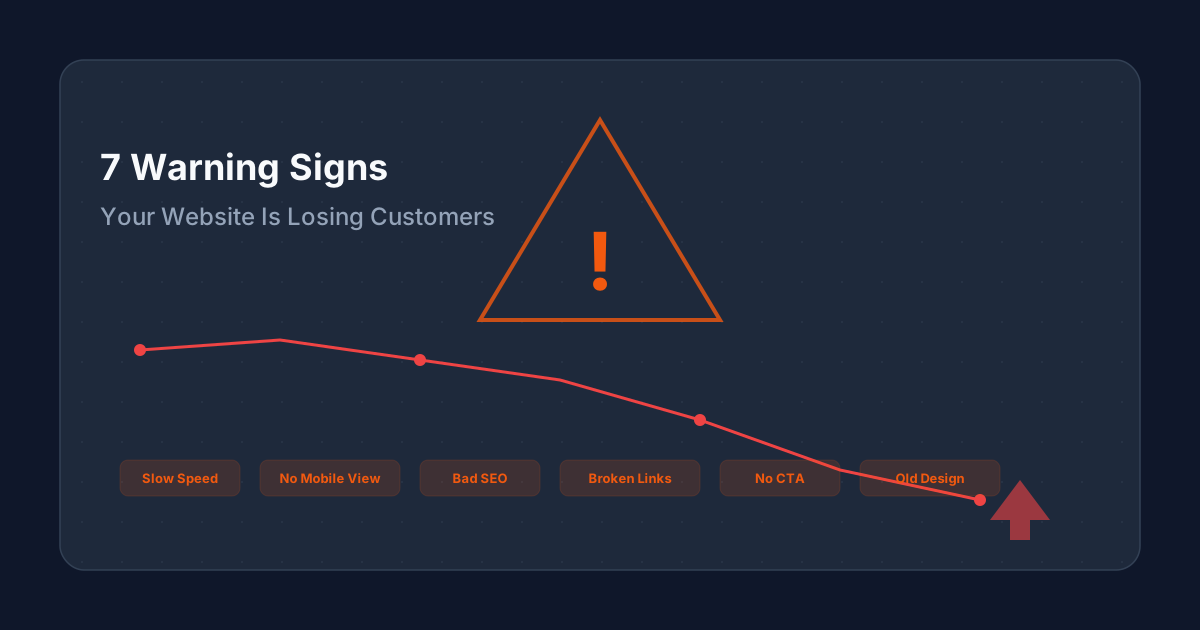
Your website might look fine to you, but if your phone is not ringing and your enquiry form is empty, something is wrong. Most Pakistani business owners assume their website is working simply because it loads. The reality is that a website losing customers does so silently. Visitors arrive, see a problem, and leave without telling you why. This guide covers the seven most common signs your business website is losing customers in Pakistan, with specific fixes for each one so you can stop the leak before your competitors capture the traffic you are paying for.
How to tell if your website is losing customers in Pakistan
Before looking at individual signs, check two numbers in your Google Analytics. First, your bounce rate: the percentage of visitors who leave after viewing only one page. A bounce rate above 70 percent on your homepage or service pages means most visitors are not finding what they need. Second, your average session duration: if visitors spend less than 30 seconds on your site, they are leaving almost immediately.
If you do not have Google Analytics installed, that is itself a sign your website is losing customers. You cannot fix the problem if you cannot measure what is happening. Install it before doing anything else.
1. Your website takes more than 3 seconds to load
Page speed is the number one reason a website losing customers fails in Pakistan, especially where most visitors browse on mobile phones over 3G and 4G connections. Google's own research shows that 53 percent of mobile visitors leave a page that takes longer than 3 seconds to load. On slower Pakistani networks, this threshold is even more critical.
The most common speed killers on Pakistani business websites are uncompressed images uploaded directly from a camera or phone, shared hosting plans that slow down during peak hours, heavy WordPress themes loaded with features you never use, and third-party scripts like chat widgets and analytics tags that block page rendering.
- Test your speed at PageSpeed Insights (pagespeed.web.dev) and note the mobile score specifically
- Compress all images to WebP format and use lazy loading so images below the fold load only when the visitor scrolls
- Switch from shared hosting to a VPS or cloud plan if your site serves more than 500 visitors per day
- Remove any WordPress plugins you are not actively using; each plugin adds load time even when invisible
- Consider a custom built website if your current theme is too bloated to optimise
2. Your website is not mobile responsive
Over 75 percent of internet traffic in Pakistan comes from mobile phones. If your website does not adapt to smaller screens, three out of four visitors see a broken layout with tiny text, horizontal scrolling, and buttons they cannot tap accurately. That is your website losing customers on the majority of devices people actually use.
Mobile responsiveness is not optional. Google uses mobile-first indexing, which means it ranks your site based on how it performs on a phone, not a desktop. A site that looks great on a laptop but breaks on a mobile screen will rank lower in search results and convert fewer visitors into enquiries.
- Test your site on your own phone first, then test on a friend's phone with a different screen size
- Use Google's Mobile Friendly Test to identify specific issues
- Check that all buttons, forms, and navigation menus work correctly on touch screens
- Make sure text is readable without zooming; body text should be at least 16px on mobile
- If your site was built more than three years ago without mobile responsiveness, a rebuild is usually more cost-effective than retrofitting; see our guide on website cost in Pakistan for realistic budgets
3. No WhatsApp button means your website losing customers silently
In Pakistan, WhatsApp is how people communicate with businesses. A visitor who finds your service page interesting wants to send a quick WhatsApp message, not fill out a contact form and wait for an email reply. If your website does not have a visible WhatsApp button, you are losing the visitors who are closest to becoming customers.
The same applies to phone numbers. A clickable phone number that dials when tapped on mobile is a basic requirement for any Pakistani business website. Displaying your number as an image or in a format that cannot be tapped to call adds unnecessary friction at the exact moment a potential customer wants to reach you.
- Add a floating WhatsApp button that stays visible as the visitor scrolls; this is the single highest-impact change for most Pakistani business websites
- Make your phone number clickable with a tel: link so mobile visitors can tap to call
- Place contact options on every page, not just the contact page; visitors decide to enquire from service pages, product pages, and even blog posts
- If you use a contact form, keep it short: name, phone number, and message. Every extra field reduces submissions
- Consider adding a WhatsApp click-to-chat link on individual product or service pages with a pre-filled message mentioning that specific item
4. Your website has no SSL certificate (no HTTPS)
When a visitor opens your website and sees "Not Secure" in the browser address bar, trust drops immediately. This warning appears when your site uses HTTP instead of HTTPS, meaning it does not have an SSL certificate. For a Pakistani business website, especially one that handles enquiries, payments, or personal information, this is a serious problem.
Google Chrome, which most Pakistani users browse with, actively warns visitors about insecure sites. Beyond the trust issue, Google also uses HTTPS as a ranking signal. A website without SSL ranks lower than an identical site with it. The fix is simple and often free: most hosting providers include a free SSL certificate through Let's Encrypt. There is no reason for any business website in 2026 to run without HTTPS.
5. Your content is generic and does not speak to Pakistani buyers
Many Pakistani business websites use generic content that could apply to any country. The service descriptions mention no cities, no local payment methods, no Pakistani customer concerns, and no context that tells a Lahore or Karachi buyer that this business understands their market. This disconnect means your website losing customers because visitors do not feel the business is relevant to them.
Pakistani buyers search with local intent. They search for "website developer in Lahore", not "website developer". They want to know if you accept JazzCash or Easypaisa, whether you deliver through TCS or Leopards, and whether you have worked with businesses in their city. If your website does not answer these questions, visitors will find a competitor whose site does.
- Mention your city and the cities you serve on your homepage and service pages
- Reference Pakistani payment methods, delivery services, and business context throughout your content
- Create location-specific pages if you serve multiple cities; a website development page for Lahore ranks for Lahore searches that a generic page never will
- Use Pakistani pricing (PKR) instead of USD unless you exclusively serve international clients
- Write case studies or examples that reference Pakistani industries and challenges your local buyers recognise
6. No trust signals visible on your website
Pakistani consumers are cautious online buyers. Years of poor experiences with low-quality websites, fake businesses, and unreliable e-commerce stores have made trust the deciding factor in whether someone contacts a business or moves on. If your website losing customers is a pattern you recognise, missing trust signals are almost always part of the problem.
Trust signals include client logos, testimonials, Google reviews, certifications, physical address, team photos, and clear information about who runs the business. A website that shows none of these looks like it could be a one-person operation working from a bedroom, even if the business is well-established offline.
- Display Google review ratings and a link to your Google Business Profile
- Add client logos (with permission) to your homepage and relevant service pages
- Show your physical office or showroom address with a Google Maps embed
- Include a clear About page with real team information rather than stock photos
- For e-commerce stores, display return policies, delivery timelines, and payment security badges prominently
- If you have certifications, awards, or industry memberships, display them; these matter more in Pakistan than in markets where online trust is already established
7. Zero SEO foundation means Google cannot send you traffic
The final sign is not something visitors see, but it determines whether they find you at all. A website with no SEO foundation has no proper heading structure, no meta descriptions, no internal linking, no keyword targeting, and no structured data. Google cannot understand what the site is about, so it does not rank for the searches your potential customers use.
Many Pakistani business websites are built with all the focus on visual design and none on search visibility. The result is a website that looks professional but generates zero organic traffic. Every visitor has to come from paid ads, social media, or word of mouth. That is not a sustainable way to grow, and it means your website losing customers extends to people you never even had a chance to reach.
- Every page should have a unique title tag and meta description targeting a specific keyword
- Use one H1 heading per page that includes your primary keyword for that page
- Build internal links between related pages; a service page should link to relevant blog posts and other services
- Submit your sitemap to Google Search Console and monitor for indexing errors
- If your site has never had an SEO audit, consider one before spending money on ads; fixing organic visibility often delivers better long-term ROI than increasing ad spend
- For industry-specific SEO strategies, see our dedicated guides like SEO for jewellers which cover keyword targeting for specific Pakistani industries
How to stop your website losing customers: prioritise these fixes
If your website losing customers is confirmed by the signs above, you do not need to fix everything at once. Start with the problems that cost you the most customers for the least effort.
- 1.Install SSL (free, takes 10 minutes, stops the "Not Secure" warning immediately)
- 2.Add a WhatsApp button (can be done in under an hour with a simple plugin or code snippet)
- 3.Fix page speed by compressing images and removing unused plugins (a few hours of work with measurable results)
- 4.Make your content Pakistan-specific by adding city names, local payment methods, and PKR pricing to existing pages
- 5.Add trust signals: Google reviews widget, client logos, physical address, and team information
- 6.Check mobile responsiveness and fix the most broken elements first
- 7.Start an SEO foundation: proper titles, meta descriptions, and heading structure on your top five pages
When fixing a website losing customers needs a full rebuild
If your website losing customers shows two or three of these problems, fixing them individually is the right approach. But if your site has five or more of these signs, a rebuild is usually more efficient and cost-effective than patching an outdated foundation.
A modern website development project in Pakistan builds all of these elements in from the start: mobile responsiveness, page speed, WhatsApp integration, SSL, SEO foundations, trust signals, and Pakistan-specific content. If the root cause of your website losing customers is the underlying theme or platform, fixing problems one by one often costs more than building correctly from scratch.