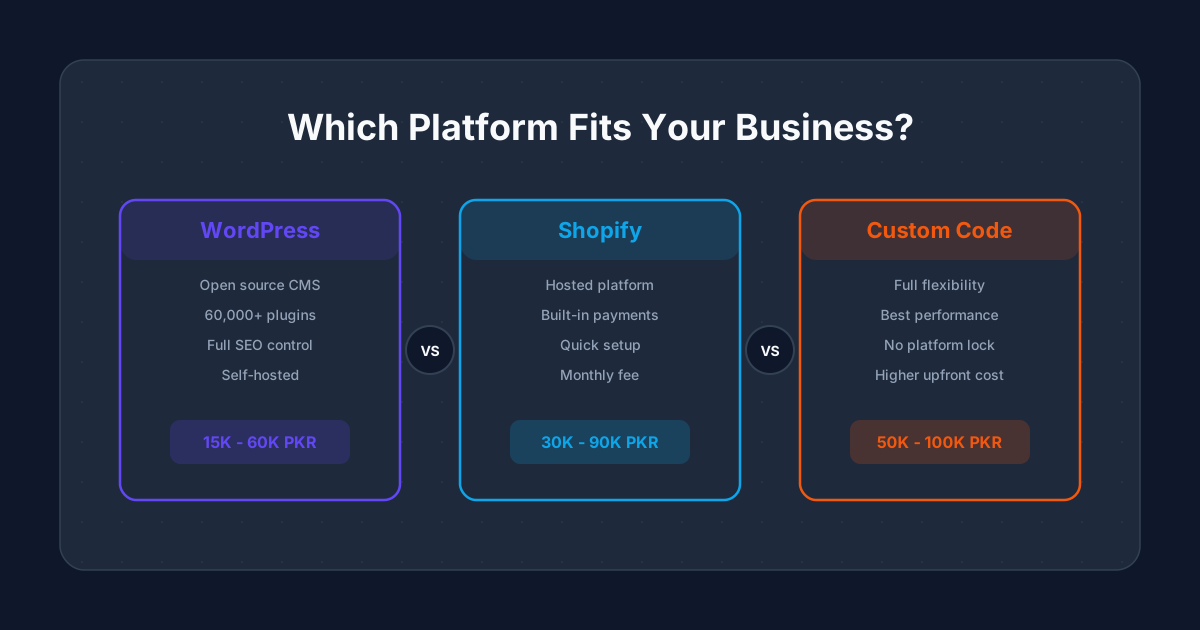
Choosing a platform is the first decision every Pakistani business owner faces when building a website, and it is also where the most expensive mistakes happen. WordPress vs Shopify is the comparison most people search for, but the real question is broader: should you use WordPress, Shopify, or custom code built on a framework like Next.js or React? Each option makes trade-offs between cost, control, speed, and flexibility. This guide compares all three honestly so you can pick the platform that fits your business, your budget, and the Pakistani market you are selling into.
Why the WordPress vs Shopify debate matters for Pakistani businesses
The platform you choose affects everything that comes after: how fast your site loads, whether JazzCash and Easypaisa work properly, how much you pay monthly, and how easily your team can manage content. Getting this decision wrong means either rebuilding in a year or working around limitations that should not exist.
In Pakistan specifically, the platform decision carries extra weight because of local payment gateways, courier integrations, and the fact that most visitors browse on mobile phones over 3G and 4G networks. A platform that works well in the US or Europe may not handle these requirements without significant customisation.
WordPress vs Shopify vs custom code: quick comparison
Before diving into detail, here is how the three platforms compare on the factors that matter most to Pakistani businesses.
| Factor | WordPress | Shopify | Custom Code (Next.js) |
|---|---|---|---|
| Upfront cost | 5,000 - 80,000 PKR | 40,000 - 90,000 PKR | 60,000 - 150,000 PKR |
| Monthly cost | Hosting only (3,000 - 10,000 PKR/yr) | USD 39+/month (11,000+ PKR) | Hosting only (5,000 - 15,000 PKR/yr) |
| JazzCash/Easypaisa | Via plugins (free to 5,000 PKR) | Custom integration needed | Built during development |
| COD support | Native WooCommerce feature | Basic toggle, needs customisation | Built during development |
| Page speed | Moderate (theme dependent) | Good (Shopify CDN) | Excellent (pre-rendered pages) |
| SEO control | Full control | Limited (URL restrictions) | Full control |
| Content management | Easy (WordPress admin) | Easy (Shopify admin) | Requires developer for most changes |
| E-commerce | WooCommerce (free plugin) | Built in | Headless commerce (Medusa/Saleor) |
| Scalability | Needs optimisation at scale | Handles scale automatically | Built for scale |
| Best for | Content sites, brochure sites, blogs, small e-commerce | Managed online stores | High-performance sites, web apps, large catalogues |
WordPress: the most flexible option for Pakistani businesses
WordPress powers over 40 percent of the internet and is the most commonly used platform in Pakistan. Its strength is flexibility: you can build anything from a five-page brochure site to a full e-commerce store with WooCommerce, and the ecosystem of themes and plugins means most features can be added without writing code from scratch.
For Pakistani businesses, WordPress has the strongest local support. JazzCash and Easypaisa plugins exist and are actively maintained. WooCommerce supports COD natively. Local developers are plentiful, which means you are not locked into one agency. If you decide to switch providers, any competent WordPress developer can pick up the project.
The weakness of WordPress is performance. A WordPress site loaded with plugins, a heavy theme, and shared hosting can easily take five to eight seconds to load on a Pakistani mobile connection. This hurts both user experience and Google rankings. A well-built WordPress site without page builder bloat performs much better, but that requires a developer who knows what to leave out, not just what to add.
- Full control over code, design, hosting, and SEO with no platform restrictions
- Largest plugin ecosystem: forms, SEO, caching, payments, shipping, analytics
- WooCommerce handles e-commerce with Pakistani payment gateways and COD built in
- You own everything: code, data, hosting account, domain. No platform dependency
- Local developers widely available at every price point across Pakistan
- Requires security management: updates, backups, and malware monitoring are your responsibility
Shopify: managed e-commerce without the technical overhead
In the WordPress vs Shopify comparison, Shopify wins on one thing: you never think about hosting, security, SSL, or software updates. Shopify handles all of it. For Pakistani business owners who want to sell online without managing a server, this is the core appeal.
Shopify's checkout is optimised for conversion globally, and its admin interface is genuinely easy to use. Your team can add products, manage orders, and update content without developer help. For businesses where selling is the priority and technical control is not, Shopify development in Pakistan removes a significant management burden.
The trade-off is cost and control. Shopify charges a monthly platform fee starting at USD 39, which adds up to roughly 132,000 PKR per year before you count development costs. You also have limited control over URLs, SEO, and checkout customisation unless you are on Shopify Plus. And the biggest challenge for Pakistani stores is that JazzCash and Easypaisa do not work natively and require custom integration work.
- Hosting, security, SSL, and updates all managed by Shopify automatically
- Easy-to-use admin that non-technical team members can manage independently
- Strong checkout conversion rates with built-in analytics and abandoned cart recovery
- Monthly platform fee (USD 39+) on top of development cost and transaction fees
- Limited SEO control: forced URL prefixes (/products/, /collections/), limited robots.txt access
- Pakistani payment gateways (JazzCash, Easypaisa) require custom integration at additional cost
Custom code (Next.js/React): maximum performance and control
Custom code means building your website on a modern framework like Next.js or React rather than using a CMS platform. The result is a website that loads faster, performs better on mobile, and gives you complete control over every aspect of the user experience.
In the WordPress vs Shopify vs custom code comparison, custom code wins on speed. Next.js pre-renders pages at build time, so your site serves static HTML from edge servers. On Pakistani 3G and 4G networks, this difference is immediately noticeable: pages load in under one second compared to three to five seconds for a typical WordPress or Shopify site.
The trade-off is editorial independence. With WordPress or Shopify, your team can log in and change any text, image, or product without a developer. With custom code, most content changes require a developer unless you add a headless CMS like Sanity or Strapi, which adds cost and complexity. Custom code is the right choice when performance is a competitive advantage, not when content updates need to happen daily without developer involvement.
- Fastest possible page loads: pre-rendered static pages served from edge CDN
- Complete control over every aspect of design, SEO, performance, and functionality
- No platform fees: you pay only for hosting and any third-party services you choose
- Requires a developer for most content changes unless paired with a headless CMS
- Smaller developer pool in Pakistan compared to WordPress; switching agencies is harder
- Higher upfront development cost, but lower ongoing costs with no monthly platform fees
Which platform fits which Pakistani business type
Rather than arguing WordPress vs Shopify in the abstract, here is which platform we recommend based on the actual business type and priorities of Pakistani companies we work with.
| Business Type | Recommended Platform | Why |
|---|---|---|
| Small business brochure site | WordPress | Lowest cost, easy content management, full SEO control, local developer availability |
| Blog or content-heavy site | WordPress | Best content management, SEO plugins, flexible taxonomy and category structure |
| Small e-commerce (under 100 products) | WordPress + WooCommerce | JazzCash/Easypaisa plugins, native COD, full control over product pages and SEO |
| Managed e-commerce (wants no server hassle) | Shopify | Automatic hosting and security, easy admin, good checkout, worth the monthly fee for hands-off operation |
| Jewellery store with large catalogue | WordPress or Shopify | Depends on team preference; both support catalogues. See our jewellery website and Shopify jewellery guides |
| High-traffic brand or portal | Next.js (custom) | Speed advantage matters at scale; pre-rendered pages handle traffic spikes without infrastructure scaling |
| SaaS product or web application | Next.js/React (custom) | Full application logic, API routes, authentication, and dynamic features that CMS platforms cannot support |
WordPress vs Shopify on Pakistani payment gateways
Payment gateway support is one of the biggest practical differences between WordPress vs Shopify for Pakistani businesses. WordPress with WooCommerce has mature, actively maintained plugins for JazzCash and Easypaisa that work out of the box. COD is a native WooCommerce feature with built-in order management.
Shopify does not natively support JazzCash or Easypaisa. Integration requires either a custom Shopify app or a third-party payment gateway provider that bridges the gap. This adds development cost and introduces a dependency on a third party. COD on Shopify is a basic toggle with no verification workflow, which leads to fake orders unless you build custom logic around it.
If accepting Pakistani payment methods with minimal development effort is a priority, WordPress with WooCommerce currently has the advantage. If you prefer Shopify's managed infrastructure and are willing to invest in custom payment integration, the gap can be closed.
WordPress vs Shopify on SEO for Pakistani search terms
SEO control is another area where WordPress vs Shopify produces a clear difference. WordPress gives you full control over URLs, meta tags, heading structure, robots.txt, XML sitemaps, internal linking, and structured data. With plugins like Yoast or Rank Math, even non-technical users can manage on-page SEO effectively.
Shopify forces URL prefixes (/products/, /collections/, /pages/) that you cannot remove, offers limited control over robots.txt, and creates duplicate content through tagged collection URLs. These are not deal-breakers, but they require deliberate development workarounds. A well-optimised Shopify store can rank, but it takes more effort than a well-optimised WordPress site.
For businesses targeting competitive Pakistani search terms like website development in Lahore or e-commerce website development in Pakistan, the SEO flexibility of WordPress or custom code is a genuine advantage.
The cost comparison over three years
When comparing WordPress vs Shopify, looking at the first year alone is misleading. Shopify's monthly fees compound over time, while WordPress and custom code have lower ongoing costs after the initial build.
| Cost Item | WordPress (3 years) | Shopify (3 years) | Custom/Next.js (3 years) |
|---|---|---|---|
| Development | 25,000 - 80,000 PKR | 40,000 - 90,000 PKR | 60,000 - 150,000 PKR |
| Hosting/platform | 9,000 - 30,000 PKR | 396,000+ PKR (USD 39 x 36) | 15,000 - 45,000 PKR |
| Domain + SSL | 6,000 - 12,000 PKR | 6,000 - 12,000 PKR | 6,000 - 12,000 PKR |
| Maintenance | 36,000 - 120,000 PKR | Included in platform fee | 36,000 - 120,000 PKR |
| Total (3 years) | 76,000 - 242,000 PKR | 442,000 - 498,000+ PKR | 117,000 - 327,000 PKR |
The numbers show that Shopify is the most expensive option over three years because of the monthly platform fee. However, cost is not the only factor. If the managed infrastructure saves you from hiring someone to handle hosting, security, and updates, the platform fee may be worth it. The right choice depends on what you value more: lower total cost or lower management overhead.
For a detailed breakdown of what each type of website costs to build in Pakistan, see our guide on how much a website costs in Pakistan in 2026.
How to decide: three questions to ask yourself
If you are still unsure after reading the WordPress vs Shopify vs custom code comparison, answer these three questions.
- 1.Do you need e-commerce? If no, WordPress is almost always the right choice for Pakistani businesses. If yes, continue to question two.
- 2.Do you want to manage your own hosting and security, or would you rather pay someone else to handle it? If you want hands-off management, Shopify is worth the premium. If you are comfortable managing hosting or have a developer on retainer, WordPress with WooCommerce gives you more control at lower cost.
- 3.Is page speed a competitive advantage for your business? If your competitors' sites load slowly and you serve a mobile-heavy Pakistani audience, custom code on Next.js gives you a measurable edge. If speed is not a differentiator, WordPress or Shopify will serve you well.