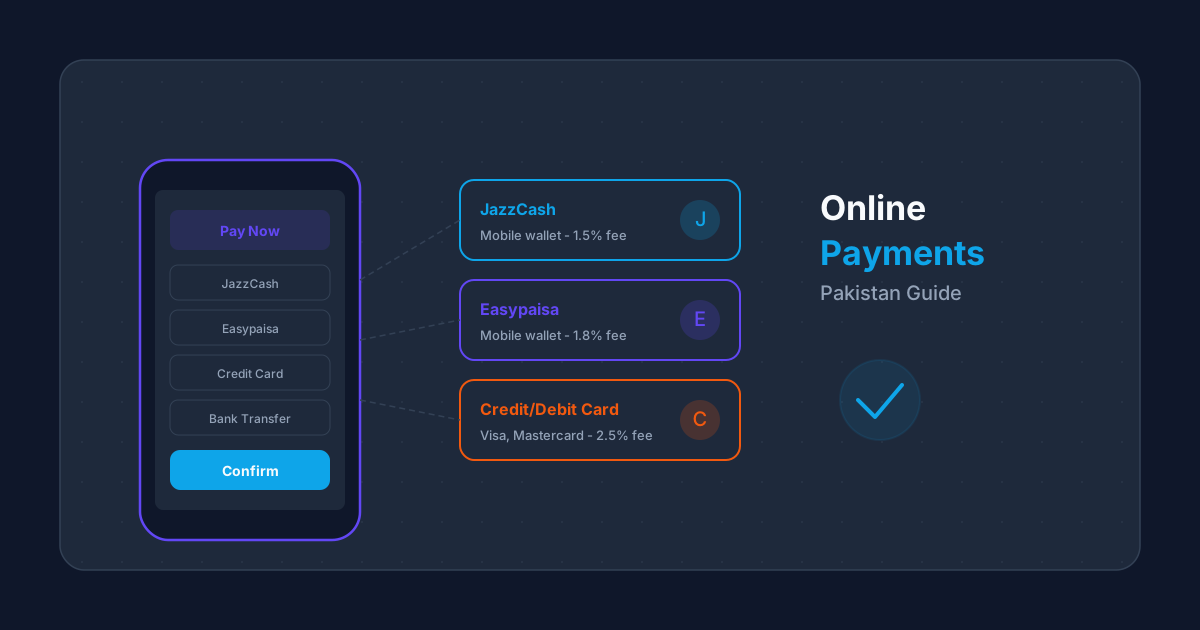
If you are building an online store or service business website in Pakistan, the question is not whether to accept online payments in Pakistan but how. The payment landscape here is different from Western markets: credit card penetration is low, mobile wallets dominate digital transactions, and cash on delivery remains the most trusted method for high-value purchases. This guide covers every way to accept online payments in Pakistan, from JazzCash and Easypaisa to cards and bank transfers, with the setup requirements, fees, and platform compatibility you need to make a decision.
The online payments in Pakistan landscape in 2026
Pakistan's digital payment ecosystem has grown rapidly, but it is still fundamentally different from markets where credit cards are the default. Understanding how Pakistanis actually pay online is essential before you choose a payment gateway or build an e-commerce store.
According to the State Bank of Pakistan, mobile wallet transactions crossed 1.5 billion in volume in recent years, with JazzCash and Easypaisa accounting for the majority. Credit and debit card usage is growing but remains concentrated in urban centres like Karachi, Lahore, and Islamabad. Meanwhile, cash on delivery still accounts for over 60 percent of e-commerce transactions by value.
This means any business accepting online payments in Pakistan needs to support multiple methods. A website that only accepts credit cards will lose the majority of potential buyers. A store that does not offer COD will struggle with high-value purchases where trust has not yet been established.
JazzCash: Pakistan's largest mobile wallet for e-commerce
JazzCash is Pakistan's most widely used mobile wallet with over 40 million active accounts. For any business selling online in Pakistan, JazzCash integration is not optional. It is how a significant portion of your customers prefer to pay.
JazzCash offers a payment gateway for websites and apps that allows customers to pay using their JazzCash wallet balance, linked bank account, or debit card. The checkout experience redirects the customer to JazzCash's payment page where they authenticate the transaction.
| Feature | Details |
|---|---|
| Transaction fee | 1.5% to 2.5% per transaction (varies by integration type) |
| Settlement time | T+1 to T+3 business days |
| Setup requirements | Business registration (NTN), CNIC of business owner, active bank account |
| WordPress/WooCommerce | Plugins available (free to 5,000 PKR); works with most themes |
| Shopify | Not natively supported; requires custom app or third-party gateway |
| Custom code | REST API available for direct integration |
| Minimum transaction | No minimum for most business categories |
The main limitation of JazzCash for e-commerce is that the redirect-based checkout can feel clunky on mobile devices. Customers leave your website, authenticate on JazzCash's page, and return. Each redirect is a potential drop-off point, especially on slower Pakistani mobile connections. Despite this, JazzCash remains essential because of the sheer number of Pakistanis who use it as their primary payment method.
Easypaisa: the second major mobile wallet
Easypaisa is Pakistan's second largest mobile wallet and a direct competitor to JazzCash. Together, these two services cover the vast majority of mobile wallet users in Pakistan. If you already accept JazzCash, adding Easypaisa is a natural next step.
Easypaisa's payment gateway works similarly to JazzCash: customers pay via wallet balance, linked bank account, or debit card through a redirect-based checkout. The fees and settlement times are comparable.
| Feature | Details |
|---|---|
| Transaction fee | 1.5% to 2.5% per transaction |
| Settlement time | T+1 to T+3 business days |
| Setup requirements | Business registration (NTN), CNIC, active bank account |
| WordPress/WooCommerce | Plugins available; some support both JazzCash and Easypaisa in one plugin |
| Shopify | Not natively supported; same custom integration path as JazzCash |
| Custom code | REST API available |
For most Pakistani e-commerce stores, offering both JazzCash and Easypaisa covers the mobile wallet segment completely. Some payment gateway aggregators like Bykea Pay, Safepay, and Stripe (limited availability in Pakistan) bundle both wallets into a single integration, which saves development time.
Credit and debit cards: growing but not universal
Credit and debit card payments are growing in Pakistan, particularly among urban professionals and younger demographics. Banks like HBL, UBL, Meezan, and MCB have expanded card issuance, and Visa and Mastercard both operate in the market. However, card penetration remains low compared to mobile wallets.
To accept card payments on your Pakistani website, you need a payment gateway that supports local card processing. The most common options include:
- HBL Pay: HBL's payment gateway for Visa and Mastercard processing. Established and widely used by Pakistani e-commerce businesses
- UBL Digital: UBL's online payment solution with card processing and bank transfer support
- Safepay: a modern Pakistani payment gateway that aggregates cards, JazzCash, Easypaisa, and bank transfers into one integration
- Stripe: available in Pakistan with limited functionality. Supports international cards well but local card coverage is still developing
- PayFast: another aggregator supporting multiple Pakistani payment methods through a single API
Card transaction fees in Pakistan typically range from 2.5 to 3.5 percent, higher than mobile wallets. Settlement times vary from T+1 to T+7 depending on the gateway and your agreement. The setup process requires business registration, a merchant account, and compliance with PCI DSS standards (which most gateways handle on your behalf).
Bank transfers: direct payments for high-value orders
For high-value purchases, particularly in industries like jewellery, real estate, and B2B services, direct bank transfers remain a common payment method in Pakistan. Many buyers prefer transferring directly to a business bank account rather than using a gateway, especially for orders above 50,000 PKR.
Integrating bank transfer as a payment option on your website is straightforward: display your bank details on the checkout page, accept the order as pending, and confirm it manually once the transfer clears. It is not automated, but for businesses with low order volume and high order value, the manual process is manageable.
For e-commerce stores processing higher volumes, some Pakistani payment gateways offer automated bank transfer verification through IBFT (Inter-Bank Fund Transfer) APIs, which reduces manual reconciliation work.
Cash on delivery: still the dominant payment method
Despite the growth of digital payments, cash on delivery remains the most used payment method for online purchases in Pakistan. Over 60 percent of Pakistani e-commerce transactions use COD, and for certain categories like fashion, electronics, and jewellery, the percentage is even higher.
COD works because it eliminates the trust barrier. Pakistani buyers who are not yet comfortable sharing financial information online, or who want to inspect a product before paying, choose COD as a risk-free option. Refusing to offer COD on your Pakistani e-commerce store means losing the majority of potential buyers.
The challenge with COD is fake orders. Without a verification step, anyone can place an order with a false phone number or address. This leads to failed deliveries, wasted courier costs, and inventory tied up in returns.
- Always verify COD orders with an automated phone call or SMS confirmation before dispatching
- Set a minimum order value for COD to reduce low-value fake orders
- Maintain a blacklist of phone numbers and addresses associated with previous fake orders
- Offer a small discount for prepaid orders to incentivise digital payments over COD
- Integrate COD reconciliation with your courier service (TCS, Leopards, M&P) so payment collection syncs back to your order system automatically
- For more on solving COD problems, see our upcoming guide on reducing fake COD orders
Which payment methods to offer on your Pakistani website
The answer depends on your business type and your customers, but for most Pakistani businesses selling online, you should offer all of the following:
| Payment Method | Why You Need It | Priority |
|---|---|---|
| JazzCash | Largest mobile wallet user base in Pakistan | Essential |
| Easypaisa | Second largest wallet; covers users JazzCash misses | Essential |
| COD | 60%+ of Pakistani e-commerce transactions; refusing it loses majority of buyers | Essential |
| Credit/debit cards | Growing segment, especially urban and high-income buyers | Important |
| Bank transfer | Preferred for high-value orders and B2B transactions | Important for high-value businesses |
If you are building on WordPress with WooCommerce, all five methods can be integrated with existing plugins and minimal development effort. If you are building on Shopify, JazzCash and Easypaisa require custom integration work. If you are using custom code, your developer can integrate directly with each gateway's API.
For a comparison of how each platform handles payments, see our guide on WordPress vs Shopify vs custom code.
How to choose a payment gateway for your Pakistani business
Rather than integrating each payment method separately, consider using a payment gateway aggregator that bundles JazzCash, Easypaisa, cards, and bank transfers into a single integration. This reduces development time and gives your customers a unified checkout experience.
- 1.Check which payment methods your customers actually use. If you sell locally in Pakistan, JazzCash, Easypaisa, and COD are non-negotiable. If you also sell internationally, you need Visa/Mastercard processing
- 2.Compare transaction fees across gateways. A 1 percent difference on fees matters at volume. Get written fee schedules before committing
- 3.Check settlement times. How quickly the gateway releases your money affects your cash flow. T+1 is ideal; T+7 may cause problems for businesses with tight margins
- 4.Verify platform compatibility. Confirm the gateway has a plugin or API for your platform (WordPress, Shopify, or custom) before signing up
- 5.Test the checkout experience on a mobile phone. Most Pakistani buyers pay on mobile. If the checkout is slow, confusing, or requires too many redirects, you will lose conversions
- 6.Ask about support. When a payment fails or a settlement is delayed, how quickly does the gateway respond? Local Pakistani support is valuable here
Common mistakes when setting up online payments in Pakistan
These are the errors we see most often when Pakistani businesses set up their payment infrastructure.
- Offering only credit cards and ignoring JazzCash and Easypaisa, which excludes the majority of Pakistani online buyers
- Not implementing COD verification, leading to 20 to 40 percent fake order rates that destroy margins
- Registering payment gateway accounts under a personal name rather than a business account, which creates problems at scale
- Not testing the payment flow on mobile devices over a 3G connection, which is how most Pakistani customers will experience it
- Ignoring failed transaction rates. If a payment method has a high failure rate, buyers will abandon your site and may not return
- Not displaying accepted payment methods on product pages. Pakistani buyers want to know they can pay with JazzCash before they add items to the cart, not after they reach checkout