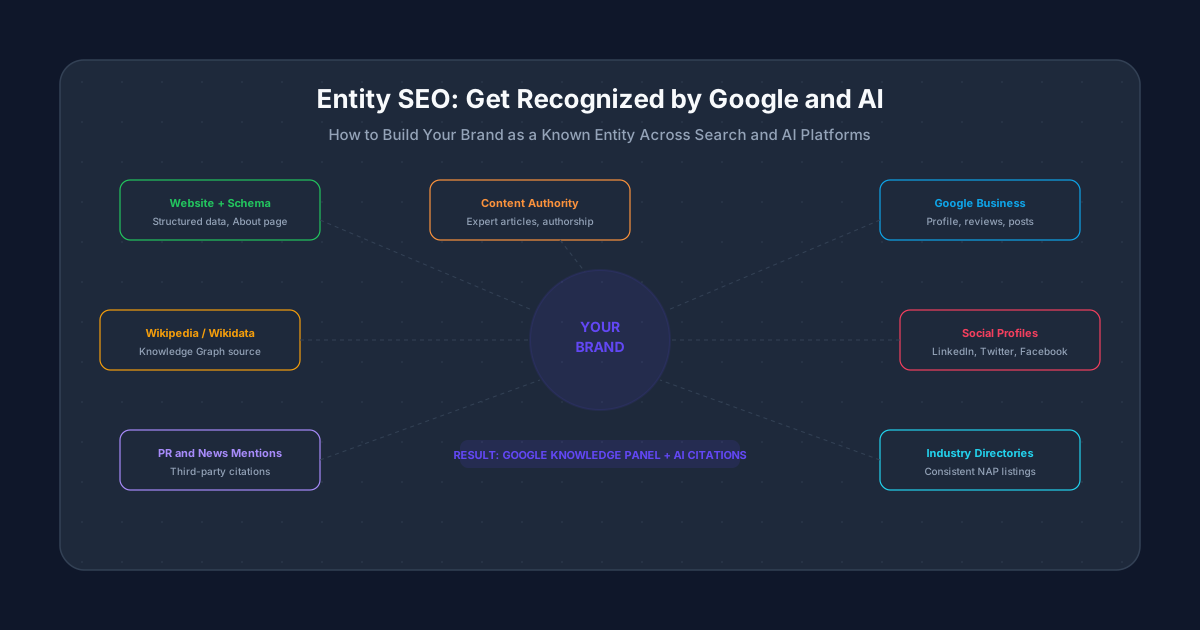
There is a question that most business owners have never asked themselves, but it might be the most important SEO question of 2026: does Google actually know what your business is? Not whether Google has indexed your website. That is a different thing entirely. I mean: does Google understand your business as a real entity in the world, with a name, a location, a category, people behind it, and a reputation? Because here is what has changed. Google is no longer just matching keywords on web pages to search queries. It is building a massive knowledge graph of real-world entities: businesses, people, places, concepts, and the connections between them. AI platforms like ChatGPT and Perplexity are doing the same thing. And if your business is not recognized as an entity in these systems, you are essentially invisible to the most powerful discovery channels that exist today.
What Is an Entity in the Eyes of Google?
Think about what happens when you Google a big company. Say you search for 'Samsung.' You do not just get a list of web pages. You get a Knowledge Panel on the right side of the screen with Samsung's logo, description, stock price, founder, headquarters, products, and social profiles. Google knows Samsung is a company. It knows what Samsung makes. It knows where Samsung is headquartered. It knows who founded it. It knows Samsung's social media accounts. All of that information comes from Google's Knowledge Graph, a database of entities and their relationships.
Now Google does this for millions of entities, not just Fortune 500 companies. Local businesses, hospitals, law firms, restaurants, agencies, freelancers. If Google recognizes your business as an entity, you get better visibility in search, you become eligible for a Knowledge Panel, and AI platforms can confidently cite you in their answers. If Google does not recognize you as an entity, you are just another website competing on keywords alone. That is a much harder game to win.
Why Entity SEO Matters More Than Traditional SEO in 2026
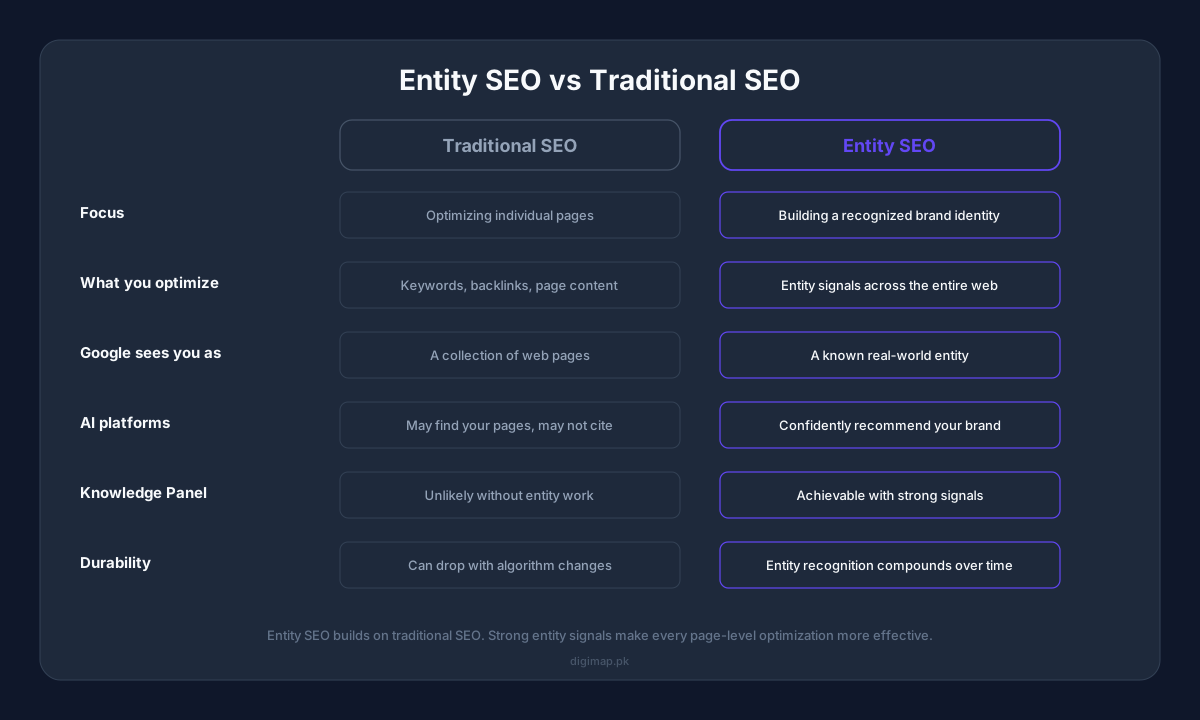
Traditional SEO was about pages. You wrote a page targeting a keyword, got some backlinks, and tried to rank that page. Entity SEO is about your entire business. It is about building a consistent, verifiable identity across the web so that Google and AI platforms trust you as a real, authoritative entity in your industry.
This matters because of how AI search works. When someone asks ChatGPT 'best digital marketing agency in Pakistan' or when Google generates an AI Overview for 'top SEO agency in Lahore,' these systems do not just scan web pages for keywords. They look at entities. They ask: which agencies are recognized entities in the marketing space in Pakistan? Which ones have consistent information across multiple trustworthy sources? Which ones have the strongest entity signals? The agencies that win are the ones Google and AI recognize as entities, not just the ones with the best-optimized web pages.
I have seen this play out dozens of times. A business with a perfectly good website, decent content, and some backlinks is stuck on page two for competitive terms. Meanwhile, a competitor with a less polished website but much stronger entity signals is ranking on page one and getting cited by ChatGPT. The difference is not content quality or backlinks. The difference is that Google knows what the competitor is. It is a recognized entity. The first business is just a website.
The Anatomy of a Strong Entity Profile
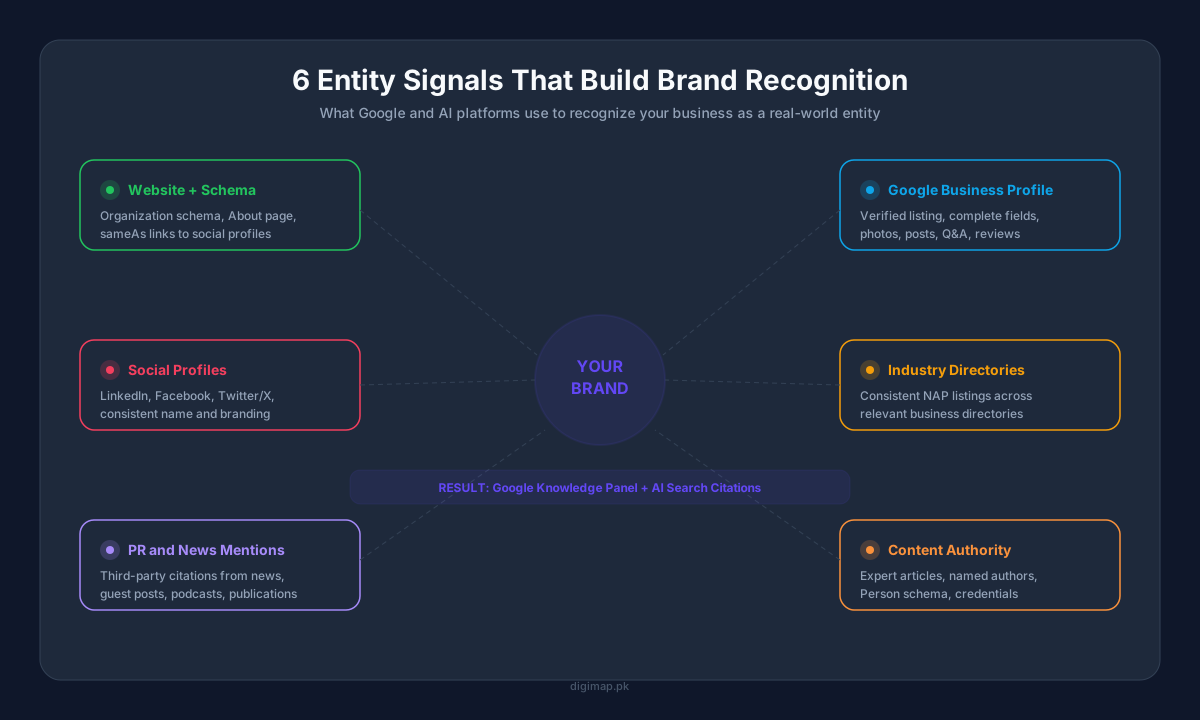
Building your brand as a recognized entity is not one action. It is a collection of signals spread across the web that all point to the same thing: your business is real, it does what it says, and trustworthy sources confirm it. Here are the pillars.
1. Your Website as the Entity Home Base
Your website is the primary source of truth about your entity. But having a website is not enough. Your website needs to explicitly tell search engines what your business is through structured data. This means implementing Organization or LocalBusiness schema with your official name, address, logo, founding date, social profiles, and a description of what you do. Every page should reinforce your entity identity, not just your homepage.
Your About page is particularly important for entity SEO. It should clearly state who you are, what you do, when you were founded, who your key people are, and what makes you distinct. Think of it as your entity's biography. Google reads this page when trying to understand what your business actually is. A vague About page with buzzwords and stock photos tells Google nothing useful. A specific, factual About page helps Google connect the dots between your website and all the other mentions of your brand across the web.
2. Google Business Profile
For local and regional businesses, your Google Business Profile is the second most important entity signal after your website. It is Google's own database of business entities. A complete, verified Google Business Profile tells Google directly: this is a real business at this address, offering these services, with these hours, these reviews, and this contact information.
The key word here is complete. An incomplete profile is like a half-filled-out ID card. Google sees it, but it does not fully trust it. Every field matters. Your categories, your services list, your description, your photos, your posts, your Q&A section. The more complete and consistently updated your profile is, the stronger your entity signal becomes.
3. Consistent Information Across the Web
This is where most businesses unknowingly sabotage their entity SEO. Your business name, address, and phone number (what SEO people call NAP) need to be identical across every place they appear online. Your website, your Google Business Profile, your Facebook page, your LinkedIn company page, your directory listings, your industry association memberships, your press mentions. Every single one.
When Google sees 'DigiMap Growth' on your website, 'DigiMap Growth Pvt Ltd' on your Facebook page, 'Digi Map' on a directory listing, and 'DigiMap Marketing' in a press article, it does not know if these are all the same entity or four different ones. That confusion weakens your entity signal dramatically. The fix is boring but powerful: audit every place your business appears online and make everything identical. Same name, same address format, same phone number.
4. Authoritative Third-Party Mentions
Google does not just believe what you say about yourself. It looks for confirmation from third parties. When your business is mentioned in news articles, industry publications, blog posts on other sites, podcast transcripts, or university websites, each mention reinforces your entity. It is like having multiple witnesses confirm your identity.
Not all mentions are equal. A mention on a high-authority news site carries far more entity weight than a mention on a random blog. But even small mentions add up over time. The goal is not to get one massive press hit. It is to build a steady pattern of third-party mentions that all refer to the same entity with consistent information. This is where digital PR becomes an entity SEO strategy, not just a link-building exercise.
5. Social Profile Verification
Your official social media profiles on LinkedIn, Twitter/X, Facebook, Instagram, and YouTube are strong entity signals. Google cross-references these to verify your business is real. The profiles themselves do not need to be active content engines. They just need to exist, be verified where possible, have consistent branding and NAP information, and link back to your website.
In your website's Organization schema, you should list all your official social profile URLs using the sameAs property. This explicitly tells Google: these are all the same entity. It is one of the simplest and most effective entity SEO actions you can take, and most businesses have not done it.
How Entity SEO Feeds AI Search Visibility
Here is the connection that makes entity SEO urgent right now. AI platforms like ChatGPT, Google AI Overviews, and Perplexity all rely on entity understanding to generate recommendations. When a user asks ChatGPT 'best AEO agency in Pakistan,' the AI is essentially querying its understanding of entities in the 'AEO agency' category that are associated with 'Pakistan.' If your business is a strong, recognized entity in that space, you get recommended. If not, you do not exist in the AI's world.
This is fundamentally different from traditional SEO where you could rank a page by targeting the right keywords even if Google did not fully understand your brand. In AI search, there are no pages to rank. There is just the AI deciding which entities to cite. And it cites the ones it trusts, which are the ones with the strongest entity signals across the web.
I keep seeing businesses pour money into content marketing and link building while ignoring entity SEO. They are building a house on sand. The content and links help, but without a solid entity foundation, the returns are capped. Fix your entity signals first, and everything else you do for SEO and AEO becomes more effective.
How to Build Your Entity: A Practical Roadmap
Enough theory. Here is exactly what to do, in order of priority.
Week 1: Audit Your Current Entity Status
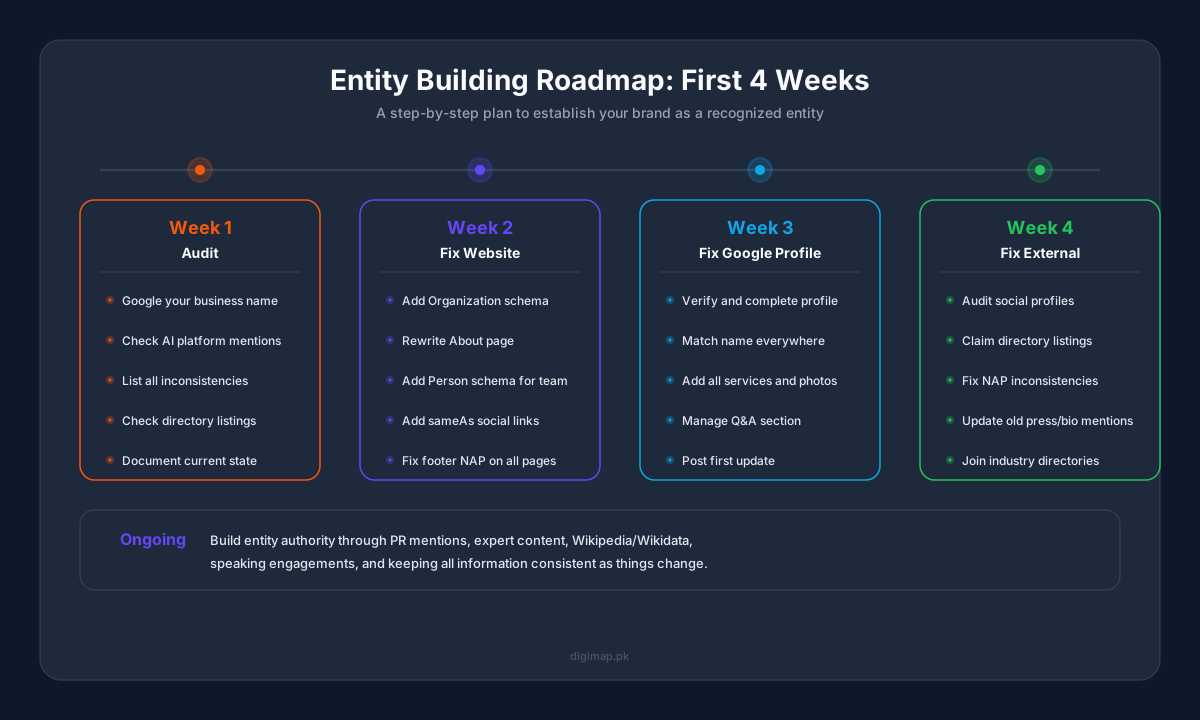
Before you fix anything, figure out where you stand. Google your business name. Do you get a Knowledge Panel? If yes, is the information accurate? If no, that is your goal. Search your business on ChatGPT and Perplexity. What do they say about you? Is the information correct? Google your business name plus your city. What shows up? Check your Google Business Profile. Is every field filled out? Are the categories right? Search for your business name on common directories and social platforms. Is the information consistent?
Write down every inconsistency you find. That list is your entity SEO to-do list.
Week 2: Fix Your Website's Entity Signals
- 1.Add or update Organization schema on your homepage with your official name, logo, founding date, description, address, phone, email, and sameAs links to all your social profiles.
- 2.Rewrite your About page to be specific and factual. Company name, what you do, when you started, who runs it, where you are based, what makes you different. No fluff.
- 3.Add Person schema for your key team members with their names, roles, and links to their LinkedIn profiles.
- 4.Make sure your website footer has your exact business name, full address, and phone number on every page.
- 5.If your website does not have an About page, create one. If it does not mention your founders or leadership team by name, add that.
Week 3: Fix Your Google Business Profile
- 1.Verify your profile if you have not already.
- 2.Make sure the business name exactly matches your website and all other listings.
- 3.Fill out every single field: categories, services, description, hours, attributes, photos.
- 4.Add your website URL, appointment link, and social profile links.
- 5.Post at least one update to show the profile is active.
- 6.Start responding to reviews if you have not been.
Week 4: Fix Your External Signals
- 1.Audit your social profiles (LinkedIn, Facebook, Twitter/X, Instagram). Make the business name, description, and contact information identical to your website.
- 2.Check your directory listings. Google your business name and visit every listing that appears. Fix inconsistencies.
- 3.Claim any unclaimed directory listings. If there is a profile for your business that you do not control, claim it and correct it.
- 4.Add your business to any relevant industry directories you are missing from.
- 5.Update any old press mentions or guest post bios that use an outdated business name or description (where you can).
Ongoing: Build Entity Authority
Once the foundation is clean and consistent, the ongoing work is about strengthening your entity signals over time.
- Get mentioned in industry publications and news sites. Even small local publications contribute to entity recognition. Digital PR is entity building.
- Publish expert content under named authors with Person schema. Content attributed to real people with verifiable credentials builds entity trust for both the person and the business.
- Build a Wikipedia page if your business is notable enough. Wikipedia is one of the primary sources Google uses for Knowledge Graph entities. This is not easy and should not be faked, but if your business has legitimate notability (press coverage, awards, industry significance), a Wikipedia presence is incredibly powerful.
- Create a Wikidata entry. Wikidata is the structured data counterpart to Wikipedia and feeds directly into Google's Knowledge Graph. You can create a Wikidata entry for your business even without a Wikipedia page, as long as you can cite reliable sources.
- Earn speaking engagements, podcast appearances, and industry recognition. Each one creates a third-party mention that reinforces your entity.
- Keep your information consistent as things change. When you move offices, change phone numbers, rebrand, or add new services, update everywhere simultaneously. A change that propagates slowly creates temporary inconsistency that can weaken your entity signals.
Entity SEO for Different Types of Businesses
The principles are the same, but the specific tactics vary depending on your business type.
- Local service businesses (hospitals, dental clinics, vet clinics): Google Business Profile is your most important entity signal. Local directories matter heavily. Focus on NAP consistency across all local listings.
- Agencies and B2B services: LinkedIn company page and personal profiles of founders/leadership are critical. Industry directory listings (Clutch, GoodFirms, etc.) add entity weight. Thought leadership content builds entity authority.
- E-commerce brands: Product schema, brand schema, and consistent brand naming across marketplaces (Daraz, Amazon) and your own website matter most. Manufacturer and product reviews on third-party sites strengthen entity signals.
- Personal brands: Person schema, author bylines on multiple publications, a strong LinkedIn profile, and Wikipedia/Wikidata entries (if notable) are the key signals. Speaking engagements and podcast appearances build third-party mention volume.
- Multi-location businesses: Each location needs its own entity signals (separate Google Business Profile, location-specific schema, local directory listings) while being clearly connected to the parent brand entity.
Common Entity SEO Mistakes
These are the mistakes I see over and over when auditing businesses that struggle with search visibility despite doing 'good SEO.'
- Using slightly different business names across platforms. 'ABC Solutions' on the website, 'ABC Solutions Pvt Ltd' on LinkedIn, 'ABC' on Google Maps. Pick one and use it everywhere.
- No Organization schema on the website. The website looks fine to humans but tells search engines nothing about the entity behind it.
- About page that says nothing specific. 'We are a passionate team of experts delivering world-class solutions.' Google cannot build an entity from that. Say who you are, where you are, what you do, and when you started.
- No sameAs links in schema. Your social profiles exist but your schema does not connect them to your entity, so Google does not know they belong to the same business.
- Ghost social profiles. You created a Twitter account in 2018, posted three times, and abandoned it. It still shows up when Google searches for your entity and it shows an inactive, incomplete business. Either maintain it or make it consistent with your current branding.
- Ignoring directory listings with wrong information. Old listings with outdated addresses, phone numbers, or business names actively confuse entity recognition.
- No personal entities for key people. The business exists as an entity but the people behind it do not. In AI search, personal authority strengthens business authority. Your CEO, founders, and subject matter experts need their own entity signals.
Measuring Entity SEO Progress
Entity SEO progress is slower to measure than traditional keyword rankings, but there are clear signals to track.
- Knowledge Panel: do you have one? Is the information accurate? Can you claim it? Getting a Knowledge Panel is the clearest sign that Google recognizes your entity.
- Branded search results: Google your business name. Do the results show a clean, consistent entity? Your website, Google Business Profile, social profiles, and directory listings should dominate the first page.
- AI citations: ask ChatGPT and Perplexity about your business directly. Ask about your industry in your region. Track whether you appear in recommendations over time.
- Search Console branded queries: are branded search impressions growing? More people searching for your name means more entity signals flowing back to Google.
- Google Business Profile insights: profile views, searches, and actions should trend upward as your entity strengthens.
- Third-party mention volume: track how many new mentions of your business appear each month across news, blogs, and directories.
Start With the Foundation
Entity SEO is not a quick hack. It is a fundamental shift in how you think about your online presence. Instead of optimizing individual pages for individual keywords, you are building a recognizable, trustworthy identity across the entire web. Every piece of consistent information, every third-party mention, every verified profile adds a brick to that foundation.
The businesses that build strong entities now will have a compounding advantage as AI search grows. ChatGPT, Google AI Overviews, and Perplexity will increasingly favour recognized entities over anonymous websites. The window to build that entity is open. The businesses that wait will find it progressively harder and more expensive to catch up. Start with the audit. Fix the inconsistencies. Build the schema. Complete the profiles. Then keep reinforcing your entity, month after month. The returns are not instant, but they are durable and they compound. If you want help with the technical implementation, an AI search optimization agency can handle the schema, audits, and strategy while you focus on running your business.