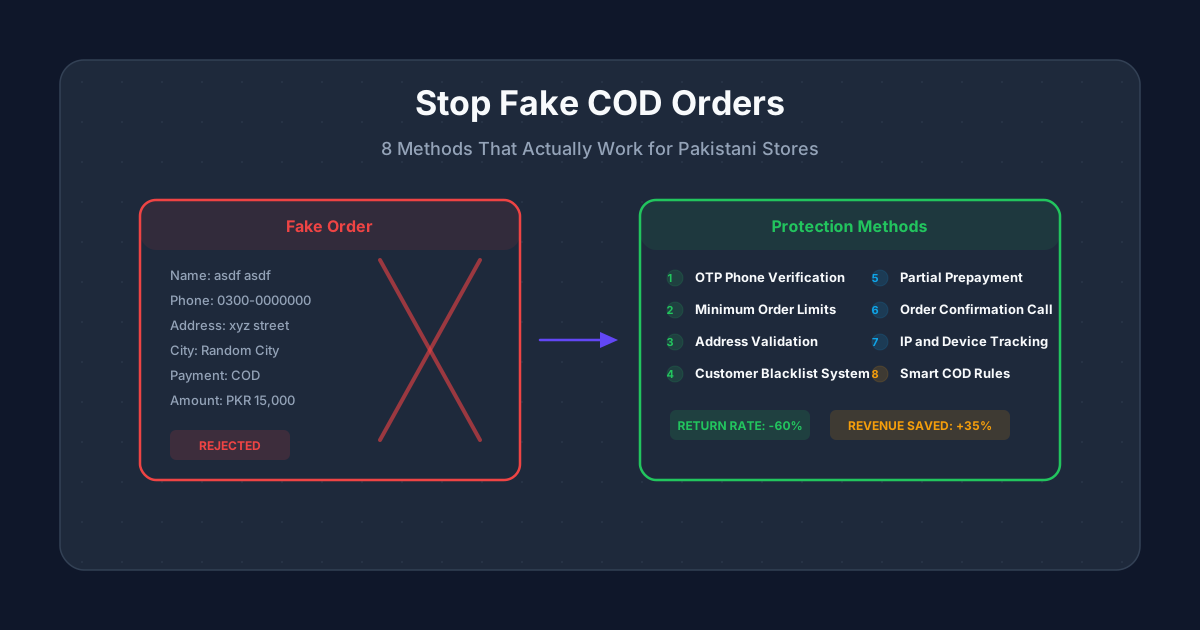
If you run an online store in Pakistan, you already know the pain of fake COD orders. A customer places an order, you pack it, ship it through TCS or Leopards, pay the courier fees, and then the buyer refuses delivery. The product comes back. You eat the shipping cost both ways. Multiply that by ten or twenty orders a week, and your margins disappear. The problem is not small. Industry estimates suggest that 15% to 30% of all COD orders in Pakistan result in returns, and a significant portion of those are fake orders placed with no intention of receiving the product. Competitors placing orders to waste your inventory, bored teenagers testing checkout flows, and serial returners who treat COD like a free trial programme all contribute to the problem. This guide covers 8 methods that actually work to reduce fake COD orders in Pakistan. These are not theoretical suggestions. They are practical systems that Pakistani ecommerce stores use every day to protect their revenue.
Why Fake COD Orders Are Such a Big Problem in Pakistan
Pakistan's ecommerce market runs on cash on delivery. Roughly 80% to 90% of all online orders in Pakistan are COD, compared to 30% to 40% in more digitally mature markets. This is not because Pakistani buyers are behind. It is because trust infrastructure is still developing. Many buyers have been burned by receiving wrong products, poor quality items, or nothing at all after paying online. COD is their insurance policy.
But COD creates an asymmetric risk. The seller bears all the cost: product sourcing, packaging, courier fees (outbound and return), warehouse handling, and the opportunity cost of inventory sitting in transit instead of being available for genuine buyers. When a fake order is placed, the seller loses money on every single touchpoint.
The Real Cost of Fake COD Orders
Most store owners underestimate how much fake COD orders actually cost because they only think about the return shipping fee. The true cost per fake order includes several hidden expenses.
| Cost Component | Typical Amount (PKR) | Notes |
|---|---|---|
| Outbound shipping | 150 to 350 | Depends on weight and destination |
| Return shipping | 150 to 350 | Often higher due to courier surcharges on returns |
| Packaging materials | 30 to 100 | Box, bubble wrap, tape, invoice |
| Labour (packing + processing return) | 50 to 150 | Your team's time has a cost |
| Payment gateway / COD fee | 30 to 80 | Some couriers charge COD handling fees |
| Inventory holding cost | Variable | Product unavailable for 5 to 14 days during transit |
| Product damage risk | Variable | Items sometimes return damaged or incomplete |
A single fake order on a product worth PKR 2,000 can cost you PKR 400 to 900 in direct losses. If you receive 50 fake orders per month, that is PKR 20,000 to 45,000 lost every month before you even count the opportunity cost. For a small Pakistani store doing 500 orders per month with a 20% fake order rate, that translates to roughly PKR 200,000 to 450,000 in annual losses. That is often the difference between profitability and shutting down.
Method 1: OTP Phone Verification
This is the single most effective method to reduce fake COD orders in Pakistan. Before confirming an order, send a one-time password via SMS to the buyer's phone number. The buyer must enter the OTP to complete checkout. This does three things: it verifies the phone number is real, it confirms the person placing the order actually controls that number, and it creates enough friction to deter casual fake orders while barely slowing down genuine buyers.
Implementation options for Pakistani stores include SMS APIs from providers like Twilio (with Pakistani number support), local providers like Jazzmessage or InfoBip, or Shopify apps like OTP Login that work with Pakistani mobile numbers. The cost is typically PKR 0.5 to 2 per SMS, which is negligible compared to the cost of a single fake order.
One important consideration: make sure your OTP system works with all Pakistani mobile networks, including Jazz, Telenor, Zong, and Ufone. Some SMS providers have better delivery rates on certain networks. Test before you go live.
Method 2: Minimum Order Limits for COD
Set a minimum order value for COD availability. Orders below the threshold must be paid online via JazzCash, Easypaisa, or card. This is effective because fake orders tend to cluster at lower price points. A competitor or troll placing 50 fake orders is far less likely to do so when the minimum COD order is PKR 3,000 versus PKR 500.
The ideal minimum depends on your product category. Fashion and accessories stores typically set COD minimums at PKR 2,000 to 3,000. Electronics stores may go higher at PKR 5,000. Jewellery stores often require partial prepayment regardless of order value due to the high product cost.
Display the minimum clearly on your product and cart pages. Something like 'COD available on orders above PKR 2,500. Pay online for smaller orders.' Transparency prevents cart abandonment from confused buyers.
Method 3: Address Validation and Standardization
Fake orders often have incomplete, vague, or obviously fabricated addresses. 'Near the big mosque' or 'opposite the park on main road' might be common in Pakistan, but a legitimate buyer will provide enough detail for a courier to find them. Build address validation into your checkout.
Practical steps include requiring separate fields for house/building number, street, area/sector, city, and postal code rather than a single free-text address field. Cross-reference the city with the phone number's area code where possible. Flag orders where the delivery city does not match the billing phone number region for manual review.
For Shopify stores in Pakistan, use address autocomplete apps or Pakistan Post's postal code database to validate locations. This does not catch every fake address, but it raises the bar enough to deter the majority of low-effort fake orders.
Method 4: Customer Blacklist System
Maintain a database of phone numbers, email addresses, and device fingerprints associated with previous fake orders. When a new order comes in, automatically check it against this blacklist. If there is a match, either block the order entirely or flag it for manual verification before shipping.
Your blacklist should include the phone number (primary identifier in Pakistan), email address, delivery address (fuzzy match on street name and city), and device fingerprint or IP address. The phone number is the most reliable identifier because Pakistani buyers frequently use different email addresses but almost always reuse the same mobile number.
For ecommerce stores built on custom platforms, this can be integrated directly into the order management system. For Shopify stores, apps like Fraud Filter or custom webhook integrations can automate the blacklist check.
Method 5: Partial Prepayment
Instead of full COD, require a partial payment at checkout. The buyer pays 10% to 30% of the order value online, and the rest is collected on delivery. This is a powerful filter because a person placing a fake order will not pay even PKR 200 to 500 upfront for a product they never intend to receive.
This method works especially well for high-value items. A jewellery store selling a PKR 50,000 necklace might require a PKR 5,000 advance payment via JazzCash or bank transfer. The advance is non-refundable if the buyer refuses delivery without a valid reason, which eliminates the financial incentive for fake orders entirely.
The key is framing. Do not call it a 'security deposit' or 'anti-fraud charge' because that signals distrust. Call it an 'advance payment' or 'booking amount' and present it as standard practice. Most Pakistani buyers understand this model because it is common in offline retail for custom or high-value products.
Method 6: Order Confirmation Call
Call every COD order before dispatching. This is manual and does not scale elegantly, but it is extremely effective, especially for smaller stores doing fewer than 100 orders per day. A 30-second phone call confirms the buyer's identity, verifies the delivery address, and gives the buyer a chance to cancel before you incur shipping costs.
Many successful Pakistani ecommerce stores use a tiered approach. Orders below PKR 2,000 from verified repeat customers ship automatically. First-time orders, high-value orders, and orders flagged by other methods (blacklist match, unusual address, mismatched phone region) get a confirmation call.
The call also serves as a customer service touchpoint. You can confirm product details, manage expectations about delivery time, and upsell complementary products. Some stores report that confirmation calls actually increase average order value by 10% to 15% through verbal upselling.
Method 7: IP and Device Tracking
Track the IP address and device fingerprint of every order. When multiple orders come from the same IP or device to different addresses with different names, that is a strong signal of fraudulent behaviour. This catches competitors placing bulk fake orders and trolls using the same device to place repeated junk orders.
Technical implementation requires storing browser fingerprint data (screen resolution, browser version, installed fonts, timezone) alongside order data. Open-source libraries like FingerprintJS provide reliable device identification. When a new order matches a device that has been associated with 2 or more previous returns, flag it for review.
This method has limits. Many Pakistani internet users share IP addresses due to NAT configurations on mobile networks, and VPN usage can mask device identity. Use IP and device tracking as one signal among many, not as a standalone filter.
Method 8: Smart COD Rules Based on Risk Score
Combine all the methods above into a scoring system. Every order gets a risk score based on multiple factors: is this a first-time buyer? Does the phone number match the delivery city? Has this device placed orders before? Is the address complete? Has the postal code been associated with returns? What time was the order placed?
Orders scoring below the risk threshold ship automatically as COD. Orders scoring above the threshold are either routed to manual review, required to pay a partial advance, or offered only prepaid checkout options. This lets you keep COD available for legitimate buyers while filtering out the high-risk orders that drain your margins.
Building a risk scoring system requires development work on your ecommerce platform, but the investment pays for itself within weeks if you are currently losing significant revenue to fake orders. Start simple with 3 to 4 factors and expand the model as you collect more data about which signals predict fake orders in your specific product category.
Which Methods to Implement First
You do not need all 8 methods on day one. Start with the two that provide the highest impact with the lowest implementation cost.
- 1.OTP phone verification. This alone can reduce fake COD orders by 40% to 60%. Implementation takes a few hours with the right SMS API, and the cost is less than PKR 2 per order.
- 2.Confirmation calls for first-time and high-value orders. No technical implementation needed. Just assign a team member to call orders before dispatch. Start immediately.
- 3.Customer blacklist. Start a simple spreadsheet of returned-order phone numbers. Upgrade to an automated system once you have 50 or more entries.
- 4.Minimum COD order value. A configuration change in your checkout settings. Takes 5 minutes.
- 5.Partial prepayment for high-value items. Requires payment gateway integration but dramatically reduces losses on expensive products.
- 6.Address validation, device tracking, and risk scoring. These require development work and should be implemented once you have the data and technical resources to build them properly.
How These Methods Affect Your Conversion Rate
The biggest concern store owners have about fake order prevention is that it will hurt legitimate sales. This is a valid concern, but the data shows the opposite. Stores that implement OTP verification typically see a 3% to 5% drop in total orders but a 15% to 25% increase in successful deliveries. The net revenue impact is positive because you are not spending money shipping orders that will come back.
The key is implementing these methods without creating unnecessary friction. OTP verification should auto-fill on mobile browsers. Address forms should use autocomplete. Minimum COD limits should be clearly displayed before the buyer reaches checkout. Partial prepayment should offer multiple payment options including JazzCash and Easypaisa for convenience.
Monitor your conversion rate before and after implementing each method. If a specific method causes a disproportionate drop in genuine orders, adjust the threshold. The goal is to filter fake orders, not to make it difficult for real buyers to purchase from you.
Pakistan-Specific Considerations
Several factors make fake COD order prevention in Pakistan different from other markets.
- Mobile-first checkout: Over 70% of Pakistani ecommerce orders come from mobile devices. Your verification methods must be mobile-friendly. OTP should auto-detect on Android. Address forms should be designed for small screens.
- Multiple SIM culture: Many Pakistanis carry 2 or 3 SIM cards. Phone number verification is still effective, but do not assume one person equals one phone number.
- Cash-dependent economy: Removing COD entirely is not an option for most Pakistani stores. The goal is to make COD smarter, not to eliminate it.
- Courier API limitations: Not all Pakistani couriers offer real-time tracking APIs. Build your confirmation and blacklist systems to work even without automated courier data.
- Regional delivery challenges: Some areas have poor address infrastructure. A delivery address that looks fake might be legitimate in a rural area. Use confirmation calls rather than automated rejection for addresses you cannot validate.
- Website speed matters: If your checkout page is slow, buyers abandon before completing OTP verification. Fast page load is a prerequisite for effective fraud prevention, not a separate concern.
When to Consider Removing COD Entirely
For most Pakistani online stores, removing COD is not practical because it would eliminate 70% to 90% of orders. However, there are situations where limiting or removing COD makes business sense.
Custom or made-to-order products should always require prepayment. A custom jewellery piece or a personalised item cannot be resold if the buyer refuses delivery. High-value items above PKR 25,000 to 50,000 should require at least 50% advance payment. Products with high return shipping costs (fragile items, heavy goods, oversized packages) should have a higher COD minimum or require partial prepayment.
If you are considering reducing COD dependency for your store, invest in building trust signals on your website: detailed product photos (follow a proper product photography process), clear return policies, genuine customer reviews, and multiple payment gateway options that give buyers confidence to pay upfront. Over time, your prepaid order ratio will naturally increase as buyers learn to trust your brand.